Today's
EarthStation1.com 15% (Or More!) Off Commemorative Memorial Title:
Best UFO Cases: Rendlesham Belgium Falcon Lake Lake Michigan MP4
DVD
Today, July 2, 2026
July 2: World UFO Day: -- "I want to
believe." These are the words of notorious X-Files hero Fox
Mulder, who convinced an entire generation that the truth is out
there - we just have to find it. But on July 2, it won't only be
sci-fi enthusiasts trying out their ET sleuthing skills, as
everyone on planet earth will have to opportunity to celebrate
World UFO Day. UFOs have been the stuff of legend for centuries,
but it wasn't until the 1950s that freaky flying saucers grabbed
national and international mainstream attention. Since then, UFOs
have captured the minds of old and young alike, and witness'
stories have proliferated around the world. World UFO Day serves
as a way for everyone to come together and watch the skies on the
same night in search of UFOs, but that's not its only purpose.
Many see the holiday as a way to spread knowledge and awareness of
UFOs, making a case for their existence, and hoping to make
disciples out of the dubious. So why July 2? For many, this date
represents the anniversary of the famed and all-but-confirmed 1947
incident in Roswell, New Mexico. Believers claim a UFO crash
landed here, deep in the American southwest, but that the
government has been covering it up ever since. What do you
believe? On Sale Till Midnight PT!
https://store.earthstation1.com/beufocarebef.html
Today's
EarthStation1.com 15% (Or More!) Off Commemorative Memorial Title:
The Yellowstone Fires Of 1988 Documentary DVD, Download, USB Drive
Today, July 2, 2026
July 2: National Wildland Firefighter
Day: -- Honors the dedicated personnel who coordinate their
efforts to protect the nation's wildlands. It's also a day to
remember the sacrifice made each time a firefighter steps into a
wildland fire. Every year, wildfires burn millions of acres across
the United States. Federal, state, local, military, contract,
international firefighters and support staff respond to many
different emergency events. These amazing individuals are the
backbone of the wildland fire community. The men and women who
work to save lives, property, infrastructure and precious natural
and cultural resources every year, deserve incredible gratitude
for their professional skills and efforts. Wildland firefighters
are highly trained emergency responders. They are an essential
part of a coordinated effort across agencies to respond to
wildland fires and other natural emergencies. They comprise crews
on the ground, air support, smokejumpers, and incident management
teams. Location-based technology tracks the location of people and
equipment during a wildland fire. This technology offers a
promising way to increase the efficiency and safety of wildfire
management. Having a real-time view of resources on an incident
enables fire managers to adjust their strategy and tactics more
quickly as conditions on the ground change. On Sale Till Midnight
PT!
https://store.earthstation1.com/the-yellowstone-fires-of-1988-documentary1988.html
Today's
EarthStation1.com 15% (Or More!) Off Commemorative Memorial Title:
The Miracle Worker (1962) Anne Bancroft Patty Duke DVD, Download,
USB
Today, July 2, 2026
July 2: World Tutors' Day: -- A day to
celebrate experts guiding learners, enhancing understanding, and
igniting curiosity to excel academically and unlock their full
potential in education. Peer tutors, college students, teachers
and many others with specific skill sets will often work on the
side or full-time as a tutor. World Tutors' Day is here to show
appreciation for those who help educate and encourage individuals
and small groups with their tutoring skills. The history of tutors
can be traced back thousands of years, starting in ancient times.
While those ancients were likely not as supportive as today's
qualified tutors are, thankfully, the practice of tutoring evolved
over time, often functioning as part of a college education. Even
today, many postgraduate students still act as tutors or teaching
assistants for undergrad students. With the hope of celebrating
the vital impact that tutors all over the globe have on children,
World Tutors' Day was established. This global awareness day was
founded by a company called Qualified Tutor to celebrate and show
tutors how much they mean! On Sale Till Midnight PT!
https://store.earthstation1.com/the-miracle-worker-dvd-1962-anne-bancroft-patty-1962.html
Today's
EarthStation1.com 15% (Or More!) Off Commemorative Memorial Title:
50 Years Together: Channel 2 And You WCBS-TV (1991) DVD MP4 USB
Drive
Today, July 2, 2026
July 2: World Sports Journalists Day
(International Sports Journalists Day): -- A holiday created in
1994 by the International Sports Press Association to celebrate
its 70th anniversary. Sports journalism developed during the 1800s
but was centered on elitist sports and was more focused on
reporting the social context of sports events. In the 1920s, the
profession began to take shape as newspapers dedicated more time
and space to sports journalism. In 1924, the A.I.P.S. was founded
in Paris, France as the L'Association Internationale de la Presse
Sportive. However, the association is now headquartered in the
Olympic capital of Lausanne, Switzerland. The A.I.P.S. is an
independent organization with 160 member associations, from which
it receives funding through membership fees and the contributions
of other international bodies and federations. According to its
website, the aim of the A.I.P.S. is "to enhance the
cooperation between its member associations in defending sport and
the professional interest of members, to strengthen the
friendship, solidarity, and common interests between sports
journalists of all nations, and to assure the best possible
working conditions for members." Sports journalism is a type
of writing that focuses on sports-centered topics. Sports
journalism developed in the 1800s, specifically the 1820s and
1830s. At the onset, reporting focused primarily on elite sports
such as horse racing and boxing, mainly targeted at the upper
class since newspapers were beyond the reach of the masses.
However, the development of the penny press opened the door to
affordable newspaper production, ultimately making them more
accessible to the lower strata of society. The 20th century
witnessed a massive boom in the popularity of sports journalism.
In 1880, only 0.4% of space was dedicated to sports in newspapers.
This figure rose to 20% by the 1920s, as newspapers began hiring
reporters exclusively for sports coverage. Today, sports
journalism utilizes not only print media but also radio,
television, and the Internet. On Sale Till Midnight PT!
https://store.earthstation1.com/50-years-together-channel-2-amp-you-dvd-wcbstv-new-y502.html
Today's
EarthStation1.com 15% (Or More!) Off Commemorative Memorial Title:
Satchmo: Louis Armstrong Biography + Bonus Title DVD MP4 USB Drive
Today, July 2, 2026
July 2: 1964: Louis Armstrong Day (1964
New York World's Fair): -- Amidst all the hoopla surrounding
Satchmo's chart-topping single "Hello Dolly", the first
song to knock The Beatles out of the No. 1 position on the pop
charts, July 2 is declared "Louis Armstrong Day" at the
World's Fair in Flushing Meadows' Corona Park -- just a few blocks
from his Corona, Queens home! On Sale Till Midnight PT!
https://store.earthstation1.com/satchmo-louis-armstrong-biography-dvd-mp4-usb-driv4.html
Today's
EarthStation1.com 15% (Or More!) Off Commemorative Memorial Title:
The American Adventure: TV History Series 1607-1876 DVD MP4 USB
Drive
Today, July 2, 2026
July 2, 1776: The Age Of Enlightenment
(The Enlightenment, The Age Of Reason): The Age Of Revolution: The
Atlantic Revolutions: The American Enlightenment: The American
Revolution: The Lee Resolution (The Resolution for Independence):
-- The Continental Congress in Philadelphia adopts the de facto
first declaration of America's independence from Great Britain,
originally introduced on June 7, by Richard Henry Lee of Virginia,
member of the Lee political family that was eventually to produce
Confederate General Robert E. Lee: "Resolved, That these
United Colonies are, and of right ought to be, free and
independent States, that they are absolved from all allegiance to
the British Crown, and that all political connection between them
and the State of Great Britain is, and ought to be, totally
dissolved. That it is expedient forthwith to take the most
effectual measures for forming foreign Alliances. That a plan of
confederation be prepared and transmitted to the respective
Colonies for their consideration and approbation." News of
this act was published that evening in The Pennsylvania Evening
Post and the next day in the Pennsylvania Gazette. The Declaration
Of Independence is the formal document which officially announced
and explained this resolution, which was approved two days later
by the Continental Congress on July 4, 1776. On Sale Till Midnight
PT!
https://store.earthstation1.com/the-american-adventure-series-us-1st-century-4-dv14.html
Today's
EarthStation1.com 15% (Or More!) Off Commemorative Memorial Title:
Gettysburg: A Video Civil War History DVD, Video Dowload, USB
Drive
Today, July 2, 2026
July 2, 1863: The American Civil War (The
Civil War, The War Between The States): The Eastern Theater Of The
American Civil War: The Gettysburg Campaign: The Battle Of
Gettysburg: -- The Battle Of Gettysburg develops into full-scale
battle after the day prior's skirmishes and struggles for
position. The Battle Of Gettysburg was fought July 1-3, 1863, in
and around the town of Gettysburg, Pennsylvania, by Union and
Confederate forces during the American Civil War. The battle
involved the largest number of casualties of the entire war and is
often described as the war's turning point. Union Maj. Gen. George
Meade's Army Of The Potomac defeated attacks by Confederate Gen.
Robert E. Lee's Army Of Northern Virginia, halting Lee's invasion
of the North. After his success at Chancellorsville in Virginia in
May 1863, Lee led his army through the Shenandoah Valley to begin
his second invasion of the North-the Gettysburg Campaign. With his
army in high spirits, Lee intended to shift the focus of the
summer campaign from war-ravaged northern Virginia and hoped to
influence Northern politicians to give up their prosecution of the
war by penetrating as far as Harrisburg, Pennsylvania, or even
Philadelphia. Prodded by President Abraham Lincoln, Maj. Gen.
Joseph Hooker moved his army in pursuit, but was relieved of
command just three days before the battle and replaced by Meade.
The day after the two armies collided on at Gettysburg on July 1,
most of both armies had assembled. The Union line was laid out in
a defensive formation resembling a fishhook. In the late afternoon
of July 2, Lee launched a heavy assault on the Union left flank,
and fierce fighting raged at Little Round Top, the Wheatfield,
Devil's Den, and the Peach Orchard. On the Union right,
Confederate demonstrations escalated into full-scale assaults on
Culp's Hill and Cemetery Hill. All across the battlefield, despite
significant losses, the Union defenders held their lines. On the
third day of battle, fighting resumed on Culp's Hill, and cavalry
battles raged to the east and south, but the main event was a
dramatic infantry assault by 12,500 Confederates against the
center of the Union line on Cemetery Ridge, known as Pickett's
Charge. The charge was repulsed by Union rifle and artillery fire,
at great loss to the Confederate army. Lee led his army on a
torturous retreat back to Virginia. Between 46,000 and 51,000
soldiers from both armies were casualties in the three-day battle,
the most costly in US history. On November 19, President Lincoln
used the dedication ceremony for the Gettysburg National Cemetery
to honor the fallen Union soldiers and redefine the purpose of the
war in his historic Gettysburg Address. On Sale Till Midnight PT!
https://store.earthstation1.com/gettysburg-a-video-history-of-the-civil-war-dvd.html
Today's
EarthStation1.com 15% (Or More!) Off Commemorative Memorial Title:
Joshua Lawrence Chamberlain American Civil War Hero DVD MP4 USB
Drive
Today, July 2, 2026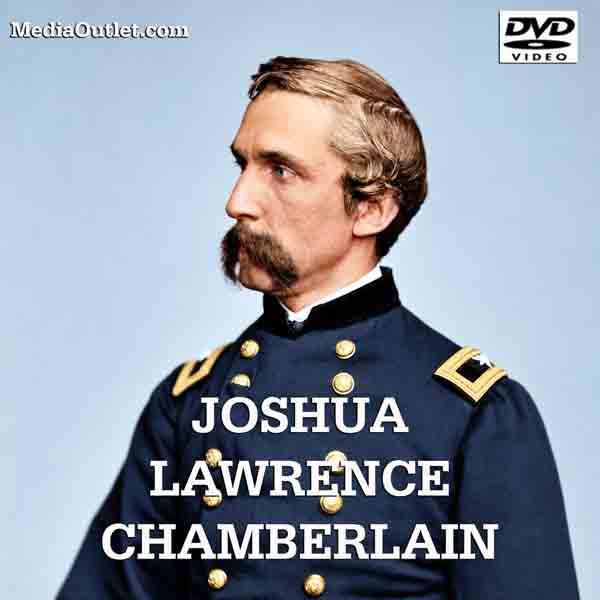
(#JCKaelin here: There are reasons for
the success of Colonel Chamberlain's successfully leading his the
20th Maine Volunteer Infantry Regiment to its glorious victory on
that day which are not privy to public textbooks... suffice it to
day that we are all obligated to help one another in times of
distress, and certainly, this moment during the battle was one of
them ; .) ========= July 2, 1863: The American Civil War (The
Civil War, The War Between The States): The Eastern Theater Of The
American Civil War: The Gettysburg Campaign: The Battle Of
Gettysburg: -- During the Battle Of Gettysburg, Union Lieutenant
Colonel Joshua Chamberlain and his the 20th Maine Volunteer
Infantry Regiment, occupying the extreme left of the Union lines
at Little Round Top, withstands repeated assaults from the
Confederate 15th Regiment Alabama Infantry, and finally drove the
Confederates away with a downhill bayonet charge that likely
changed the course of the American Civil War. Chamberlain was
severely wounded while commanding a brigade during the Second
Battle of Petersburg in June 1864, and was given what was intended
to be a deathbed promotion to brigadier general. For his gallantry
at the Battle Of Gettysburg, for which he was awarded the Medal Of
Honor, America's highest award for valor. In April 1865, he fought
at the Battle of Five Forks and was given the honor of commanding
the Union troops at the surrender ceremony for the infantry of
Robert E. Lee's Army at Appomattox Court House, Virginia.
Following the war, he served as Governor of Maine, and the
President of Bowdoin College. On Sale Till Midnight PT!
https://store.earthstation1.com/joshua-lawrence-chamberlain-american-civil-war-hero-dvd-mp4-usb-driv4.html
Today's
EarthStation1.com 15% (Or More!) Off Commemorative Memorial Title:
Roots Of Resistance: The Underground Railroad DVD, MP4, USB Drive
Today, July 2, 2026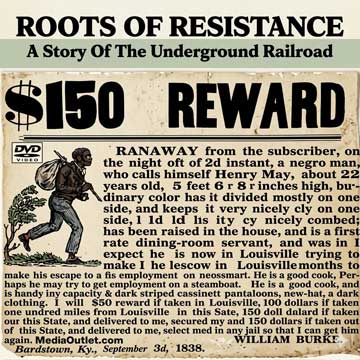
July 2, 1822: Slavery In The United
States: Slavery: Slavery In The United States: Slave Rebellions:
Slavery In The United States: Slave Rebellions In The United
States: Denmark Vesey's Failed 1822 Slave Revolt: -- #DOTD: #RIP:
Free Black pastor and community leader Denmark Vesey is hanged
along with thirty-five slaves in South Carolina after being
accused of organizing a slave rebellion. Vesey and five slaves
were rapidly judged guilty by the secret proceedings of a
city-appointed court and immediately executed; in later
proceedings, some 30 additional followers were also executed.
Another group, including his son Sandy, were convicted of
conspiracy and deported from the United States. In the summer of
1822, an about 55 years old Vesey allegedly used his influential
position as pastor to plan a major slave revolt. According to the
accusations, Vesey and his followers planned to kill slaveholders
in Charleston, liberate the slaves, and sail to the newly
independent black republic of Haiti for refuge. By some
contemporary accounts, the revolt would have involved thousands of
slaves in the city as well as others who lived on nearby
plantations. City officials sent a militia to arrest the plot's
leaders and many suspected followers before the rising could
begin, and no white people were killed or injured. City
authorities ordered that Vesey's church should be razed and its
minister was expelled from the city. Although the alleged plot was
discovered before it could be realized, its potential scale stoked
the fears of the antebellum planter class that led to increased
restrictions on both slaves and free blacks. On Sale Till Midnight
PT!
https://store.earthstation1.com/roots-of-resistance-a-story-of-the-underground-railroad-dvd.html
Today's
EarthStation1.com 15% (Or More!) Off Commemorative Memorial Title:
Eyes On The Prize II: America At The Racial Crossroads DVD MP4 USB
Today, July 2, 2026
July 2, 1917 : White Supremacy:
Terrorism: Anti-Black Racism: Anti-Black Racism In The United
States: The Nadir Of American Race Relations (1877/1890 -
1901/1923/1941 [Dates Disputed]): Race Riots: Race Riots In The
United States: Union Violence In The United States: Labour Revolts
(Labor Revolts, Labor Revoltutions, Labour Revoltutions, Worker's
Uprisings): The East St. Louis Massacre (The East St. Louis Riots,
The East St. Louis Pogrom): -- A race riot known as The East St.
Louis Massacre climaxes, in East St. Louis, Illinois, a series of
outbreaks of labor and race-related violence by white people on
May 28 and between July 1-3, 1917, who murdered between 40 and 250
African Americans; hundreds more were injured, and another 6,000
blacks were left homeless. The rioting and vandalism cost
approximately 400K US (7.982M USD in 2020) in property damage.
They have been described as the worst case of labor-related
violence in 20th-century American history, and among the worst
pogroms in U.S. history. The events took place in and near East
St. Louis, Illinois, an industrial city on the east bank of the
Mississippi River, directly opposite the city of St. Louis,
Missouri. White mobs angered by the increasing numbers of Southern
African Americans working at East St. Louis plants took their
revenge against black East St. Louis residents. The July 1917
episode in particular was marked by white-led violence throughout
the city. African Americans were beat to death, shot, lynched and
driven into burning buildings by whites. In the aftermath, the
East St. Louis Chamber of Commerce called for the resignation of
the local police chief because officers were told not to shoot
white citizens (resulting in only 9 whites being killed) and were
unable to suppress the violence and destruction. At the end of
July, some 10,000 black citizens marched in silent protest in New
York City, led down Fifth Avenue by W.E.B. DuBois and James Weldon
Johnson, in condemnation of the pogrom. A number of black people
left the city permanently; black enrollment in public schools in
the area had dropped by 35% by the time schools opened in the
fall. In a political cartoon by William Charles Morris of the New
York Evening Mail about the East St. Louis massacres, the caption
reads, "Mr. President, why not make America safe for
democracy?", referring to President Woodrow Wilson's
catch-phrase "The world must be made safe for democracy"
(shown on the document he holds). In a mass meeting in Carnegie
Hall on July 12 in New York City, Samuel Gompers, the president of
the American Federation Of Labor, tried to diminish the role in
the massacre attributed to trade unions. He said that an
investigation was needed in order to place blame. Theodore
Roosevelt, former president of the United States, responded, "Mr.
Gompers, why don't I accuse afterwards? I'll answer now, when
murder is to be answered." Roosevelt also was reported to
say, "I will go to the extreme to bring justice to the
laboring man, but when there is murder I will put him down."
Congressman Leonidas C. Dyer (R-MO), a representative from a St.
Louis urban district, asked for a federal investigation. President
Woodrow Wilson wrote to him on July 28, saying that special agents
of the Department of Justice could not find enough evidence to
justify federal action in the matter. He said: "I am informed
that the attorney general of the State of Illinois has gone to
East St. Louis to add his efforts to those of the officials of the
county and city in pressing prosecutions under the State laws. The
representatives of the Department of Justice are so far as
possible lending aid to the State authorities in their efforts to
restore tranquility and guard against further outbreaks."
Hearings on the riots before the Committee on Rules and the House
of Representatives began on August 3, 1917. A federal
investigation was eventually opened. In October the state tried 25
blacks and 10 whites on charges related to the riot, including
homicide and incitement to riot. Lena Cook survived an attack to
testify against two white men, who had killed her husband Ed Cook
and son, 14-year-old Lurizza Beard; they were convicted of murder.
Included among the defendants was Dr. LeRoy Bundy, a black dentist
and prominent leader in the East St. Louis black community. He was
formally charged with inciting a riot. The trial was held in the
county court of St. Clair County, Illinois. Bundy, along with 34
other defendants, of whom 10 were white, was convicted and
sentenced to prison in connection with the riot. Another source
said that a total of nine whites and twelve blacks were convicted
of serious crimes and sent to prison. On Sale Till Midnight PT!
https://store.earthstation1.com/eyes-on-the-prize-ii-dvd-set-4-discs-complete-2nd-seri42.html
Today's
EarthStation1.com 15% (Or More!) Off Commemorative Memorial Title:
WWII Films: African Americans At War Films Set DVD, MP4, USB Drive
Today, July 2, 2026
July 2, 1943: The European Civil War:
World War II: The Second European War (The European Theater Of
World War II): Aviation: Military Aviation: Air Warfare Of World
War II: The Tuskegee Airmen: First African Americans: -- Charles
Hall, also known as Charles B. Hall or Buster Hall (August 25,
1920 - November 22, 1971), American combat fighter pilot with the
Tuskegee Airmen of the "Red Tails", the 332nd Fighter
Group's 99th Fighter Squadron, becomes the first African American
fighter pilot to earn the Distinguished Flying Cross (DFC) when he
became the first African American fighter pilot to shoot down an
enemy aircraft, which is also the first aerial combat victory for
the 99th Fighter Squadron. It occured happened while Hall, who was
flying a Curtiss P-40 Warhawk, was escorting North American B-25
Mitchell bombers over Italy during his eighth combat mission.
General Dwight D. Eisenhower, with senior officers General Jimmy
Doolittle, General Carl Spaatz and Major General John K. Cannon,
visited the 99th Fighter Squadron's base to personally
congratulate Charles Blakesly Hall after his victory. On Sale Till
Midnight PT!
https://store.earthstation1.com/wwii-films-africanamericans-at-war-dvd.html
Today's
EarthStation1.com 15% (Or More!) Off Commemorative Memorial Title:
The Making Of The President 1964 LBJ & Goldwater Campaigns MP4
Or DVD
Today, July 2, 2026
July 2, 1964: Civil Rights Movements: The
American Civil Rights Movement (1954-1968): Anti-Racism:
Anti-Racism In The United States: Anti-Discrimination Law In The
United States: The Civil Rights Act Of 1964: -- President Lyndon
B. Johnson enacts with his signature The Civil Rights Act Of 1964,
a landmark civil rights and labor law, which outlaws
discrimination on the basis of race, color, religion or national
origin in schools, public accommodations, publicly owned or
operated facilities, employment and union membership and in voter
registration. As of 2020, the act further prohibits discrimination
on the basis of sex, sexual orientation or gender indentity. The
Act allowed for cutoff of Federal funds in places where
discrimination remained. Initially, powers given to enforce the
act were weak, but these were supplemented during later years.
Congress asserted its authority to legislate under several
different parts of the United States Constitution, principally its
power to regulate interstate commerce under Article One (section
8), its duty to guarantee all citizens equal protection of the
laws under the Fourteenth Amendment, and its duty to protect
voting rights under the Fifteenth Amendment. The legislation had
been proposed by President John F. Kennedy in June 1963, but it
was opposed by filibuster in the Senate. After Kennedy was
assassinated on November 22, 1963, President Lyndon B. Johnson
pushed the bill forward. The United States House Of
Representatives passed the bill on February 10, 1964, and after a
54-day filibuster, passed the United States Senate on June 19,
1964. The final vote was 290-130 in the House of Representatives
and 73-27 in the Senate. After the House agreed to a subsequent
Senate amendment, the Civil Rights Act was signed into law by
President Johnson at the White House. In June 2020, the Supreme
Court Of The United States ruled in Bostock v. Clayton County and
two other cases that employment protections against discrimination
on the basis of sex also apply to discrimination on the basis of
sexual orientation and gender identity. On Sale Till Midnight PT!
https://store.earthstation1.com/the-making-of-the-president-1964-dvd-johnson-goldwater-campa1964.html
Today's
EarthStation1.com 15% (Or More!) Off Commemorative Memorial Title:
An Open Mind Special Race Relations In Crisis DVD, Download, USB
Drive
Today, July 2, 2026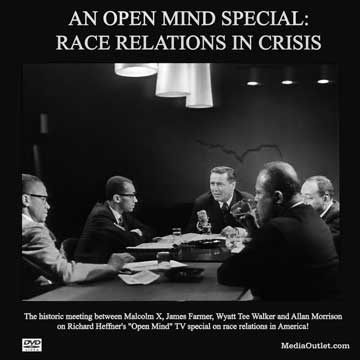
July 2, 1925: #BOTD: #HBD! Medgar Evers,
African American civil rights activist in Mississippi, the state's
field secretary of the NAACP, and a Prince Hall Freemason (d. June
12, 1963) is #born Medgar Wiley Evers in Decatur, Mississippi. He
worked to overturn segregation at the University of Mississippi,
to end segregation of public facilities, and to expand
opportunities for African Americans, including enforcement of
voting rights. A World War II veteran and college graduate, Evers
became active in the Civil Rights Movement in the 1950s. Following
the 1954 ruling of the United States Supreme Court in Brown v.
Board of Education that segregated public schools were
unconstitutional, Evers challenged the segregation of the
state-supported public University of Mississippi, applying to law
school there. He also worked for voting rights, economic
opportunity, access to public facilities, and other changes in the
segregated society. Evers was awarded the 1963 NAACP Spingarn
Medal. As a veteran, Evers was buried with full military honors at
Arlington National Cemetery. His murder and the resulting trials
inspired civil rights protests; his life and these events inspired
numerous works of art, music, and film. All-white juries failed to
reach verdicts in the first two trials of Beckwith due to hung
juries in the 1960s. On February 5, 1994, Beckwith (November 9,
1920 - January 21, 2001) was convicted in a new trial based on new
evidence and sentenced to life in prison. Seven years after being
convicted of killing Evers, De La Beckwith died in prison in 2001
at the age of 80. Medgar's widow Myrlie Evers became a noted
activist in her own right, serving as national chair of the NAACP.
His brother Charles Evers was the first African American mayor
elected in Mississippi in the post-Reconstruction era when he won
in 1969 in Fayette. On June 12, 1963, Medgar Evers was
assassinated in front of his wife and children in the driveway of
his house Jackson, Mississippi, by a rifle bullet from an ambush
by white supremacist and Klansman from Greenwood, Mississippi
Byron De La Beckwith, a member of the White Citizens' Council, a
group was formed in 1954 to resist racial integration of schools,
civil rights activism and voter registration reform, all efforts
Evers been an outspoken leader of as a NAACP organizer. That
evening, The Open Mind, the longest running in the history of
American public television, broadcast live a two-hour Race
Relations In America Special Report which dealt with the
assassination and the state of the movement a mere two months
before The March On Washington, with host Richard Heffner
moderating the discussion between panelists James Farmer, founder
and National Director of CORE, the Congress Of Racial Equality;
Wyatt Tee Walker, Chief Of Staff of the Southern Christian
Leadership Congress lead by Martin Luther King; Allan Morrison,
New York editor of Ebony magazine; and Nation Of Islam leader
Malcolm X, striking a contrary and eerily prophetic tone in the
midst of this plaintive and urgent discussion. On Sale Till
Midnight PT!
https://store.earthstation1.com/open-mind-race-relations-in-crisis-dvd-june-12-1963-mal121963.html
Today's
EarthStation1.com 15% (Or More!) Off Commemorative Memorial Title:
Simple Justice Brown v Board Of Education Docudrama DVD, Download,
USB
Today, July 2, 2026
July 2, 1908 : #BOTD: #HBD! Thurgood
Marshall, African American lawyer, civil rights activist, jurist,
Associate Justice of the Supreme Court, 32nd Solicitor General of
the United States, first African American Supreme Court justice on
the U.S. Supreme Court (from October 1967 until October 1991), and
Prince Hall Freemason (d. January 24, 1993) is #born in Baltimore,
Maryland. Prior to his judicial service, he successfully argued
several cases before the Supreme Court, including Brown v. Board
of Education. Marshall graduated from the Howard University School
of Law in 1933. He established a private legal practice in
Baltimore before founding the NAACP Legal Defense and Educational
Fund, where he served as executive director. In that position, he
argued several cases before the Supreme Court, including Smith v.
Allwright, Shelley v. Kraemer, and Brown v. Board of Education,
the latter of which held that racial segregation in public
education is a violation of the Equal Protection Clause. In 1961,
President John F. Kennedy appointed Marshall to the United States
Court of Appeals for the Second Circuit. Four years later,
President Lyndon B. Johnson appointed Marshall as the United
States Solicitor General. In 1967, Johnson successfully nominated
Marshall to succeed retiring Associate Justice Tom C. Clark.
Marshall retired during the administration of President George H.
W. Bush, and was succeeded by Clarence Thomas. Thurgood Marshall
died of heart failure at the National Naval Medical Center in
Bethesda, Maryland at the age of 84. After he lay in repose in the
Great Hall of the United States Supreme Court Building, he was
buried in Arlington National Cemetery. He was survived by his
second wife and their two sons. On Sale Till Midnight PT!
https://store.earthstation1.com/simple-justice-brown-v-board-of-education-segregation-battle-dvd.html
Today's
EarthStation1.com 15% (Or More!) Off Commemorative Memorial Title:
TV Music & Dance Shows #10 Shindig & Shinrock DVD, MP4,
USB Drive
Today, July 2, 2026
July 2, 1939: #BOTD: #HBD! Paul Williams,
African American singer and choreographer, one of the founding
members and original lead singer of the Motown group The
Temptations (d. August 17, 1973) is #born in the Ensley
neighborhood of Birmingham, Alabama, where he was raised. Along
with David Ruffin, Otis Williams, and fellow Alabamians Eddie
Kendricks and Melvin Franklin, Williams was a member of The
Temptations during the "Classic Five" period. Paul
Williams and his bandmates endured a long series of failed singles
before finally hitting the Billboard Top 20 in 1964 with "The
Way You Do the Things You Do". More hits quickly followed,
including "My Girl", "Ain't Too Proud To Beg"
and "(I Know) I'm Losing You". Although Williams had
been the group's original lead singer during its formative years,
by 1965, his role had been eclipsed by David Ruffin and Eddie
Kendricks, who had both sung lead on Temptations hit singles. As
such, Williams was often overlooked for leads, even on album
tracks and B-sides, prompting him to complain "Shit, I can
sing too!" In response, he was given lead vocals on the song,
"Don't Look Back" (1965). Williams sang lead on several
of the group's songs, and served as the main lead singer during
the group's early years. His early leads include, "Your
Wonderful Love" (1961), "Slow Down Heart" (1962),
"I Want a Love I Can See" (1963), and "Oh, Mother
of Mine" (1961) (the group's first single) and "Farewell
My Love" (1963) both shared with Eddie Kendricks. Considered
the Temptations' best dancer, Williams served as the group's
original choreographer, devising routines for his group and the
Supremes (most notably their trademark "Stop! In the Name of
Love" routine), before Cholly Atkins took over that role for
all of Motown's acts. Williams' later leads on Temptations songs
include, "Just Another Lonely Night" (1965), "No
More Water in the Well" (1967), and a cover version of "Hey
Girl" (1969). Williams also sang lead with Dennis Edwards,
who joined in 1968, on Motown's first Grammy Award-Winner "Cloud
Nine". One of his best-known lead performances is his stand
out live performance of "For Once in My Life", from the
television special TCB, originally broadcast on December 9, 1968,
on NBC. The live version of the song "Don't Look Back"
is also frequently cited as one of his standout performances. He
also took over the lead vocal for live performances of "My
Girl" following David Ruffin's departure from the group. Paul
Williams died of an apparent but suspicious suicide in Detroit,
Michigan, two years after personal problems and failing health
forced Williams to retire, aged 34. Paul Williams was found dead
inside a car parked in an alley having just left the new house of
his then-girlfriend after an argument. A gun was found near his
body. His death was ruled an apparent suicide. According to fellow
Temptations member Otis Williams, Paul had expressed suicidal
thoughts to him and Melvin Franklin months before his death.
Williams's funeral was held on August 24, with his family and
former bandmates in attendance. He was survived by his wife, Mary
Agnes Williams, and five children: Sarita, Kenneth, Paula, Mary
and Paul Jr. Paul Jr later joined a Temptations splinter group,
the Temptations Review featuring Dennis Edwards. Williams also had
three other children, Paul Williams Lucas, Anthony Johnson, and
Derrick Vinyard, with three girlfriends. Williams is buried at
Lincoln Memorial Park Cemetery, Clinton Township, Macomb County,
Michigan in Lot 275, Grave #4, Section #G. The circumstances
surrounding Williams's death caused the Williams family to suspect
that some form of foul play was the actual cause of Williams's
death. According to the coroner, Williams had used his right hand
to shoot himself on the left side of his head. In addition, a
bottle of alcohol was found near Williams's left side, as if he
had dropped it while being shot. The gun used in the shooting was
found to have fired two shots, only one of which had killed
Williams. On Sale Till Midnight PT!
https://store.earthstation1.com/classic-tv-music-amp-dance-shows-10-best-of-shindig-shinrock-d10.html
Today's
EarthStation1.com 15% (Or More!) Off Commemorative Memorial Title:
The Fabulous Sixties with Peter Jennings TV Docuseries MP4 Or DVD
Set
Today, July 2, 2026
July 2, 1925: #BOTD: Patrice Lumumba,
Congolese politician and independence leader who served as the
first prime minister of the Democratic Republic of the Congo (then
known as the Republic of the Congo) from June until September
1960, following the May 1960 election (d. January 17, 1961) is
#born Patrice Emery Lumumba in Onalua, in the Katakokombe region
of the Kasai province of the Belgian Congo. He was the leader of
the Congolese National Movement (MNC) from 1958 until his
execution in January 1961. Ideologically an African nationalist
and pan-Africanist, he played a significant role in the
transformation of the Congo from a colony of Belgium into an
independent republic. Shortly after Congolese independence in June
1960, a mutiny broke out in the army, marking the beginning of the
Congo Crisis. Lumumba appealed to the United States and the United
Nations for help to suppress the Belgian-supported Katangan
secessionists led by Moise Tshombe. Both refused, due to
suspicions among the Western world that Lumumba secretly held
pro-communist views. These suspicions deepened when Lumumba turned
to the Soviet Union for assistance, which the CIA described as a
"classic communist takeover". This led to growing
differences with President Joseph Kasa-Vubu and chief-of-staff
Joseph-Desire Mobutu, as well as with the United States and
Belgium, who opposed the Soviet Union in the Cold War. After
Mobutu's military coup, Lumumba attempted to escape to
Stanleyville to join his supporters who had established a new
anti-Mobutu rival state called the Free Republic of the Congo.
Lumumba was captured and imprisoned en route by state authorities
under Mobutu. He was handed over to Katangan authorities, and
executed in the presence of Katangan and Belgian officials and
officers in circumstances suggesting the support and complicity of
the governments of Belgium and the United States. His body was
thrown into a shallow grave, but later dug up and destroyed.
Following his execution, he was widely seen as a martyr for the
wider pan-African movement. Over the years, inquiries have shed
light on the events surrounding Lumumba's death and, in
particular, on the roles played by Belgium and the United States.
In 2002, Belgium formally apologised for its role in the
execution. In 2022, a gold-capped tooth, all that remained of his
body, was repatriated to the Democratic Republic of the Congo by
Belgium. On Sale Till Midnight PT!
https://store.earthstation1.com/decades-the-1960s-dvd-set-peter-jennings-tv-series-3-19603.html
Today's
EarthStation1.com 15% (Or More!) Off Commemorative Memorial Title:
Marconi: Sparks That Shook The World DVD, Video Download, USB
Drive
Today, July 2, 2026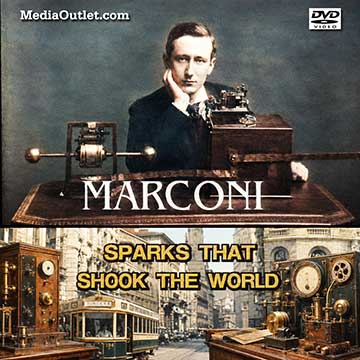
July 2, 1897: Great Inventions: The
History Of Broadcasting: The History Of Radio: -- British-Italian
engineer Guglielmo Marconi obtains a patent for radio in London.
On April 25, 1874, Guglielmo Marconi, 1st Marquis of Marconi,
Italian inventor, entrepreneur, businessman and electrical
engineer known for his pioneering work on long-distance radio
transmission and for his development of Marconi's Law and a radio
telegraph system (d. 1937) was born in Bologna, Italy. He
pioneered the use of wireless telegraphy in the 1890s. By 1921,
Marconi's invention had been developed into wireless telephony
(voice radio). He is therefore often credited as the inventor of
radio, and he shared the 1909 Nobel Prize in Physics with Karl
Ferdinand Braun "in recognition of their contributions to the
development of wireless telegraphy". Marconi was founder of
The Wireless Telegraph and Signal Company in the United Kingdom in
1897, which ultimately became the Marconi Company. He succeeded in
making an engineering and commercial success of radio by
innovating and building on the work of previous experimenters and
physicists, such as Sir Oliver Joseph Lodge, John Stone Stone, and
especially Nikola Tesla. In 1929, Marconi was ennobled as a
Marchese (marquis) by King Victor Emmanuel III of Italy and, in
1931, he set up the Vatican Radio for Pope Pius XI. In 1943, six
years after Marconi's death, and in the midst of World War II
hostilities against Italy, the Supreme Court Of The United States
declared Marconi's claim to certain patents were questionable,
especially those regarding being the "inventor" of
radio, and handed down a decision on Marconi's radio patents,
restoring some of the prior patents of Oliver Lodge, John Stone
Stone, and Nikola Tesla. Nevertheless, the decision was not about
Marconi's original radio patents, and the court declared that
their decision had no bearing on Marconi's claim as the first to
achieve radio transmission - despite their ruling that he could
not claim infringement on those very same patents. On Sale Till
Midnight PT!
https://store.earthstation1.com/marconi-sparks-that-shook-the-world-dvd-radio-inventor.html
Today's
EarthStation1.com 15% (Or More!) Off Commemorative Memorial Title:
Reaching For The Skies Documentary TV Series DVD, Download, USB
Drive
Today, July 2, 2026
July 2, 1900: Aviation: The History Of
Aviation: Lighter Than Air Aviation (Lighter-Than-Air-Aviation):
The History Of Ballooning: The History Of Airships (The History Of
Dirigibles, The History Of Dirigible Balloons): The History Of
Rigid Airships: Zeppelins: -- The first Zeppelin flight takes
place when the LZ 1 took to the air over Lake Constance near
Friedrichshafen, Germany. In 1898 Count Zeppelin founded the
Gesellschaft zur Foerderung der Luftschiffahrt (Society for the
Promotion of Airship Flight), contributing more than half of its
800,000 mark share-capital himself. Responsibility for the detail
design was given to Kober, whose place was later taken by Ludwig
Duerr, and construction of the first airship began in 1899 in a
floating assembly-hall or hangar in the Bay of Manzell near
Friedrichshafen on Lake Constance (the Bodensee). The intention
behind the floating hall was to facilitate the difficult task of
bringing the airship out of the hall, as it could easily be
aligned with the wind. The LZ 1 (LZ for Luftschiff Zeppelin, or
"Zeppelin Airship") was 128 metres (420 ft) long with a
hydrogen capacity of 11,000 m3 (400,000 cu ft), was driven by two
15 horsepower (11 kW) Daimler engines each driving a pair of
propellers mounted either side of the envelope via bevel gears and
a driveshaft, and was controlled in pitch by moving a weight
between its two nacelles. The first flight took place on 2 July
1900 over Lake Constance. Damaged during landing, it was repaired
and modified and proved its potential in two subsequent flights
made on 17 and 2October 4 1900, bettering the 6 m/s (21.6 km/h,
13.4 mph) velocity attained by the French airship La France.
Despite this performance, the shareholders declined to invest more
money, and so the company was liquidated, with Count von Zeppelin
purchasing the ship and equipment. The Count wished to continue
experimenting, but he eventually dismantled the ship in 1901.
Donations, the profits of a special lottery, some public funding,
a mortgage of Count von Zeppelin's wife's estate and a 100,000
mark contribution by Count von Zeppelin himself allowed the
construction of LZ 2, which made only a single flight on 17
January 1906. After both engines failed it made a forced landing
in the Allgau mountains, where a storm subsequently damaged the
anchored ship beyond repair. Incorporating all the usable parts of
LZ 2, its successor LZ 3 became the first truly successful
Zeppelin. This renewed the interest of the German military, but a
condition of purchase of an airship was a 24-hour endurance trial.
This was beyond the capabilities of LZ 3, leading Zeppelin to
construct his fourth design, the LZ 4, first flown on 20 June
1908. On 1 July it was flown over Switzerland to Zurich and then
back to Lake Constance, covering 386 km (240 mi) and reaching an
altitude of 795 m (2,600 ft). An attempt to complete the 24-hour
trial flight ended when LZ 4 had to make a landing at Echterdingen
near Stuttgart because of mechanical problems. During the stop, a
storm tore the airship away from its moorings on the afternoon of
5 August 1908. It crashed into a tree, caught fire, and quickly
burnt out. No one was seriously injured. This accident would have
finished Zeppelin's experiments, but his flights had generated
huge public interest and a sense of national pride regarding his
work, and spontaneous donations from the public began pouring in,
eventually totalling over six million marks. This enabled the
Count to found the Luftschiffbau Zeppelin GmbH (Airship
Construction Zeppelin Ltd.) and the Zeppelin Foundation. On Sale
Till Midnight PT!
https://store.earthstation1.com/reaching-for-the-skies-entire-aviation-history-tv-series-6-dvd6.html
Today's
EarthStation1.com 15% (Or More!) Off Commemorative Memorial Title:
Norman's Corner (1987) Gilbert Gottfried TV Special DVD, Download,
USB
Today, July 2, 2026
July 2, 1947: #BOTD: #HBD! Larry David,
American actor, comedian, producer, writer, screenwriter, director
and television producer, is #born Lawrence Gene David in the
neighborhood of Sheepshead Bay, in the Brooklyn borough of New
York City, into a Jewish family of German and Ukrainian ancestry.
He and Jerry Seinfeld created the television sitcom Seinfeld, on
which David was head writer and executive producer for the first
seven seasons. He gained further recognition for the HBO series
Curb Your Enthusiasm, which he created and stars in as a
semi-fictionalized version of himself. He has written or
co-written the stories of every episode since its pilot episode in
1999. David's work on Seinfeld won him two Primetime Emmy Awards
in 1993, for Outstanding Comedy Series and Outstanding Individual
Achievement in Writing in a Comedy Series. Formerly a comedian, he
went into television comedy, writing and starring in ABC's
Fridays, and writing briefly for Saturday Night Live. He has been
nominated for 27 Primetime Emmy Awards and three Golden Globe
Awards. He was voted by fellow comedians and comedy insiders as
the 23rd greatest comedy star ever in a 2004 British poll to
select "The Comedian's Comedian", and received the
Laurel Award for TV Writing Achievement by the Writers Guild of
America in 2010. Since 2015, he has made recurring guest
appearances on Saturday Night Live, where he impersonates 2016 and
2020 U.S. presidential candidate Bernie Sanders. On Sale Till
Midnight PT!
https://store.earthstation1.com/norman39s-corner-1987-dvd-gilbert-gottlfried-comedy-s391987.html
Today's
EarthStation1.com 15% (Or More!) Off Commemorative Memorial Title:
Insanity On Trial James Garfield's Killer Charles Guiteau DVD MP4
USB
Today, July 2, 2026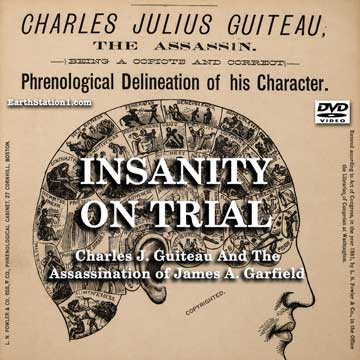
July 2, 1881: United States Presidential
Assassination Attempts And Plots: United States Presidential
Assassinations: The Assassination Of James A. Garfield: -- Charles
J. Guiteau, American writer and lawyer, shoots and fatally wounds
U.S. President James Garfield at 9:30 am at the Baltimore and
Potomac Railroad Station in Washington, D.C. Charles Julius
Guiteau falsely believed he had played a major role in Garfield's
victory, for which he should be rewarded with a consulship.
Guiteau was so offended by the Garfield administration's
rejections of his applications to serve in Vienna or Paris as
payment of this imagined political debt that he decided to kill
him. Garfield died 79 days later in Elberon, New Jersey on
September 19, 1881 from infections related to the wounds, less
than four months into his term as president. Once Garfield died,
the government officially charged Guiteau with murder. He was
formally indicted on October 14, 1881, on the charge of murder,
which was previously attempted murder after his arrest. Guiteau
pleaded not guilty to the charge. The trial began on November 17,
1881, in Washington, D.C. The presiding judge in the case was
Walter Smith Cox. Although Guiteau would insist on trying to
represent himself during the entire trial, the court appointed
Leigh Robinson to defend Guiteau. In less than a week of trial,
Robinson retired from the case. George Scoville then became lead
counsel for the defense. While Scoville's legal experience lay in
land title examination, he had married Guiteau's sister and was
thus obliged to defend him in court when no one else would. Wayne
MacVeagh, the U.S. Attorney General, served as the chief
prosecutor. MacVeagh named five lawyers to the prosecution team:
George Corkhill, Walter Davidge, retired judge John K. Porter,
Elihu Root, and E.B. Smith. Guiteau's trial was one of the first
high-profile cases in the United States where a defense based on a
claim of temporary insanity was considered. Guiteau vehemently
insisted that while he had been legally insane at the time of the
shooting (because God had taken away his free will), he was not
really medically insane, which was one of the major causes of the
rift between him and his defense lawyers. Edward Charles Spitzka,
a leading alienist (an archaic term for a psychiatrist or
psychologist), testified as an expert witness. Spitzka had stated
that it was clear "Guiteau is not only now insane, but that
he was never anything else." While on the stand, Spitzka
testified that he had "no doubt" that Guiteau was both
insane and "a moral monstrosity". Spitzka came to the
conclusion that Guiteau had "the insane manner" he had
so often observed in asylums, adding that Guiteau was a "morbid
egotist" with "a tendency to misinterpret the real
affairs of life". He thought the condition to be the result
of "a congenital malformation of the brain". George
Corkhill, who was the District of Columbia's district attorney and
on the prosecuting team, summed up the prosecution's opinion of
Guiteau's insanity defense in a pre-trial press statement that
also mirrored public opinion on the issue: "He's no more
insane than I am. There's nothing of the mad about Guiteau: he's a
cool, calculating blackguard, a polished ruffian, who has
gradually prepared himself to pose in this way before the world.
He was a deadbeat, pure and simple. Finally, he got tired of the
monotony of deadbeating. He wanted excitement of some other kind
and notoriety... and he got it." Guiteau became something of
a media sensation during his entire trial for his bizarre
behavior, which included his frequently cursing and insulting the
judge, most of the witnesses, the prosecution, and even his
defense team, as well as formatting his testimony in epic poems
which he recited at length, and soliciting legal advice from
random spectators in the audience via passed notes. He dictated an
autobiography to the New York Herald, ending it with a personal ad
for "a nice Christian lady under 30 years of age". He
was oblivious to the American public's hatred of him, even after
he was almost assassinated twice himself. He frequently smiled and
waved at spectators and reporters in and out of the courtroom.
Guiteau sent a letter in which he argued that Arthur should set
him free because he had just increased Arthur's salary by making
him president. At one point, Guiteau argued before Cox that
Garfield was killed not by the bullets but by medical malpractice
("The doctors killed Garfield, I just shot him").
Throughout the trial and up until his execution, Guiteau was
housed at St. Elizabeths Hospital in the southeastern quadrant of
Washington, D.C. While in prison and awaiting execution, Guiteau
wrote a defense of the assassination he had committed and an
account of his own trial, which was published as The Truth and the
Removal. To the end, Guiteau was making plans to start a lecture
tour after his perceived imminent release and to run for president
himself in 1884, while at the same time continuing to delight in
the media circus surrounding his trial. He was found guilty on
January 25, 1882. After the guilty verdict was read, Guiteau
stepped forward, despite his lawyers' efforts to tell him to be
quiet, and yelled at the jury saying "You are all low,
consummate jackasses!" plus a further stream of curses and
obscenities before he was taken away by guards to his cell to
await execution. Guiteau appealed his conviction, but his appeal
was rejected. Twenty-nine days before his execution, Guiteau
composed a lengthy poem asserting that God had commanded him to
kill Garfield to prevent Secretary James G. Blaine's "scheming"
to war with Chile and Peru. Guiteau also claimed in the poem that
Vice President Chester A. Arthur knew the assassination had saved
the United States and that Arthur's refusal to pardon him was the
"basest ingratitude". Guiteau also (incorrectly)
presumed that now-President Arthur would pressure the Supreme
Court into hearing his court appeal. Guiteau was executed by
hanging in Washington, D.C. at approximately 10 A.M. for the
assassination, just two days before the first anniversary of his
shooting him. While being led to his execution, Guiteau was said
to have continually smiled and waved at spectators and reporters.
He notoriously danced his way to the gallows and shook hands with
his executioner. On the scaffold, as a last request, he recited a
poem called "I am Going to the Lordy", which he had
written during his incarceration. He had originally requested an
orchestra to play as he sang his poem, but this request was
denied. After he finished reading his poem, a black hood was
placed over the smiling Guiteau's head and moments later the
gallows trapdoor was sprung, the rope breaking his neck instantly
with the fall. Guiteau's body was not returned to his family, as
they were unable to afford a private funeral, but was instead
autopsied and buried in a corner of the jailyard. Upon his autopsy
it was discovered that Guiteau had the condition known as
phimosis, an inability to retract the foreskin, which at the time
was thought to have caused the insanity that led him to
assassinate Garfield. With tiny pieces of the hanging rope already
being sold as souvenirs to a fascinated public, rumors immediately
began to swirl that jail guards planned to dig up Guiteau's corpse
to meet demands of this burgeoning new market. Fearing scandal,
the decision was made to disinter the corpse. The body was sent to
the National Museum of Health and Medicine in Maryland, which
preserved Guiteau's brain as well as his enlarged spleen
discovered at autopsy and bleached the skeleton. These were placed
in storage by the museum. Parts of Guiteau's brain remain on
display in a jar at the Mutter Museum in Philadelphia. On Sale
Till Midnight PT!
https://store.earthstation1.com/insanity-on-trial-charles-guiteau-assassination-of-james-garfield-dvd.html
Today's
EarthStation1.com 15% (Or More!) Off Commemorative Memorial Title:
Hermann Hesse Documentary Biography DVD, Video Download, USB Drive
Today, July 2, 2026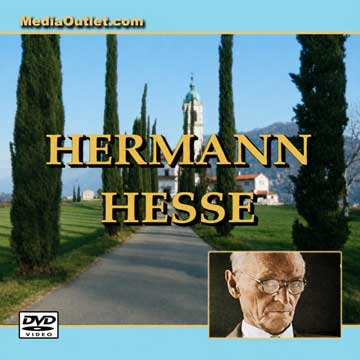
July 2, 1877: #BOTD: #HBD! Hermann Hesse,
German-born Swiss poet, novelist, and painter, Nobel Prize
laureate (d. August 9, 1962) is #born Hermann Karl Hesse in the
Black Forest town of Calw in Wurttemberg, German Empire. His
best-known works include Demian, Steppenwolf, Siddhartha, and The
Glass Bead Game, each of which explores an individual' search for
authenticity, self-knowledge and spirituality. In 1946, he
received the Nobel Prize in Literature. In "Nobel Lectures,
Literature 1901-1967", edited by Horst Frenz of the Elsevier
Publishing Company, Amsterdam (1969), the following
autobiography/biography was written at the time of his Nobel
award, and first published in the book series "Les Prix
Nobel": "I was born in Calw in the Black Forest on July
2, 1877. My father, a Baltic German, came from Estonia; my mother
was the daughter of a Swabian and a French Swiss. My father's
father was a doctor, my mother's father a missionary and
Indologist. My father, too, had been a missionary in India for a
short while, and my mother had spent several years of her youth in
India and had done missionary work there. My childhood in Calw was
interrupted by several years of living in Basle (1880-86). My
family had been composed of different nationalities; to this was
now added the experience of growing up among two different
peoples, in two countries with their different dialects. I spent
most of my school years in boarding schools in Wuerttemberg and
some time in the theological seminary of the monastery at
Maulbronn. I was a good learner, good at Latin though only fair at
Greek, but I was not a very manageable boy, and it was only with
difficulty that I fitted into the framework of a pietist education
that aimed at subduing and breaking the individual personality.
From the age of twelve I wanted to be a poet, and since there was
no normal or official road, I had a hard time deciding what to do
after leaving school. I left the seminary and grammar school,
became an apprentice to a mechanic, and at the age of nineteen I
worked in book and antique shops in Tubingen and Basle. Late in
1899 a tiny volume of my poems appeared in print, followed by
other small publications that remained equally unnoticed, until in
1904 the novel Peter Camenzind, written in Basle and set in
Switzerland, had a quick success. I gave up selling books, married
a woman from Basle, the mother of my sons, and moved to the
country. At that time a rural life, far from the cities and
civilization, was my aim. Since then I have always lived in the
country, first, until 1912, in Gaienhofen on Lake Constance, later
near Bern, and finally in Montagnola near Lugano, where I am still
living. Soon after I settled in Switzerland in 1912, the First
World War broke out, and each year brought me more and more into
conflict with German nationalism; ever since my first shy protests
against mass suggestion and violence I have been exposed to
continuous attacks and floods of abusive letters from Germany. The
hatred of the official Germany, culminating under Hitler, was
compensated for by the following I won among the young generation
that thought in international and pacifist terms, by the
friendship of Romain Rolland, which lasted until his death, as
well as by the sympathy of men who thought like me even in
countries as remote as India and Japan. In Germany I have been
acknowledged again since the fall of Hitler, but my works, partly
suppressed by the Nazis and partly destroyed by the war; have not
yet been republished there. In 1923, I resigned German and
acquired Swiss citizenship. After the dissolution of my first
marriage I lived alone for many years, then I married again.
Faithful friends have put a house in Montagnola at my disposal.
Until 1914 I loved to travel; I often went to Italy and once spent
a few months in India. Since then I have almost entirely abandoned
travelling, and I have not been outside of Switzerland for over
ten years. I survived the years of the Hitler regime and the
Second World War through the eleven years of work that I spent on
the Glasperlenspiel (1943) [Magister Ludi], a novel in two
volumes. Since the completion of that long book, an eye disease
and increasing sicknesses of old age have prevented me from
engaging in larger projects. Of the Western philosophers, I have
been influenced most by Plato, Spinoza, Schopenhauer, and
Nietzsche as well as the historian Jacob Burckhardt. But they did
not influence me as much as Indian and, later, Chinese philosophy.
I have always been on familiar and friendly terms with the fine
arts, but my relationship to music has been more intimate and
fruitful. It is found in most of my writings. My most
characteristic books in my view are the poems (collected edition,
Zurich, 1942), the stories Knulp (1915), Demian (1919), Siddhartha
(1922), Der Steppenwolf (1927) [Steppenwolf], Narziss und
Goldmund. (1930), Die Morgenlandfahrt (1932) [The Journey to the
East], and Das Glasperlenspiel (1943) [Magister Ludi]. The volume
Gedenkblatter (1937, enlarged ed. 1962) [Reminiscences] contains a
good many autobiographical things. My essays on political topics
have recently been published in Zurich under the title Krieg und
Frieden (1946) [War and Peace]. I ask you, gentlemen, to be
contented with this very sketchy outline; the state of my health
does not permit me to be more comprehensive." Hermann Hesse
(1877-1962) received the Goethe Prize of Frankfurt in 1946 and the
Peace Prize of the German Booksellers in 1955. A complete edition
of his works in six volumes appeared in 1952; a seventh volume
(1957) contains essays and miscellaneous writings. Beschworungen
(1955) [Evocations], a volume of late prose, and his
correspondence with Romain Rolland (1954) were published
separately. Hermann Hesse died of a Cerebral Hemorrhage in
Montagnola, Switzerland on August 9. 1962, aged 85, and was buried
in the cemetery of Sant'Abbondio in Gentilino, where his friend
and biographer Hugo Ball and another German personality, the
conductor Bruno Walter are also buried. On Sale Till Midnight PT!
https://store.earthstation1.com/hermann-hesse-dvd.html
Today's
EarthStation1.com 15% (Or More!) Off Commemorative Memorial Title:
America: The Second Century Documentary Series DVD, Download, USB
Today, July 2, 2026
July 2, 1890: Economics: Economic
Competition: Monopolies (Trusts): The Progressive Era In The
United States (1896-1917): The Sherman Antitrust Act of 1890: --
The U.S. Congress passes the Sherman Antitrust Act, a landmark
federal statute in the history of United States antitrust law (or
"competition law") passed by Congress in 1890 under the
presidency of Benjamin Harrison. It allowed certain business
activities that federal government regulators deem to be
competitive, and recommended the federal government to investigate
and pursue trusts. In the general sense, a trust is a
centuries-old legal arrangement whereby one party conveys property
to a trustee to hold for a beneficiary. These are commonly used to
hold inheritances for the benefit of children, for example. The
specific sense from 19th-century America used in the law refers to
a type of trust which combines several large businesses for
monopolistic purposes - to exert complete control over a market -
though the law addresses monopolistic practices even if they have
nothing to do with this specific legal arrangement. In most
countries outside the United States, antitrust law is known as
"competition law". The law attempts to prevent the
artificial raising of prices by restriction of trade or supply.
"Innocent monopoly", or monopoly achieved solely by
merit, is perfectly legal, but acts by a monopolist to
artificially preserve that status, or nefarious dealings to create
a monopoly, are not. The purpose of the Sherman Act is not to
protect competitors from harm from legitimately successful
businesses, nor to prevent businesses from gaining honest profits
from consumers, but rather to preserve a competitive marketplace
to protect consumers from abuses. Over time, the act has also been
used more broadly, to oppose the combination of entities that
could potentially harm competition, such as monopolies or cartels.
On Sale Till Midnight PT!
https://store.earthstation1.com/america-the-second-century-us-2nd-100-years-history-621006.html
Today's
EarthStation1.com 15% (Or More!) Off Commemorative Memorial Title:
Amelia Earhart Documentary Biography DVD, Video Download, USB
Drive
Today, July 2, 2026
July 2, 1937: Aviation: The History Of
Aviation: The History Of Transcontinental Flight: The History Of
Transpacific Flight: Aviation Incidents And Accidents: The Final
Flight Of Amelia Earhardt: -- #DOTD? #RIP?: In a Purdue
University-funded Lockheed Model 10-E Electra, Amelia Earhart and
navigator Fred Noonan are last heard from over the Pacific Ocean
while attempting to make the first equatorial round-the-world
flight, and disappeared over the central Pacific Ocean near
Howland Island. Fascination with her life, career, and
disappearance continues to this day. Amelia Mary Earhart (born
July 24, 1897; disappeared July 2, 1937) was an American aviation
pioneer and author. Earhart was the first female to fly in an
aircraft across the Atlantic Ocean and first female aviator to fly
solo across the Atlantic Ocean. She received the United States
Distinguished Flying Cross for this accomplishment. She set many
other records, wrote best-selling books about her flying
experiences and was instrumental in the formation of The
Ninety-Nines, an organization for female pilots. In 1935, Earhart
became a visiting faculty member at Purdue University as an
advisor to aeronautical engineering and a career counselor to
women students. She was also a member of the National Woman's
Party and an early supporter of the Equal Rights Amendment. A 2018
forensic analysis of bones found on the remote Pacific island of
Nikumaroro in the Phoenix Island chain of the island country of
Kiribati in 1940 strongly suggests they belonged to Amelia
Earhart. The remains were originally ruled to be male, but the
bone's measurements were run through modern forensics software,
which found that not only were the bones female, they matched
Earhart better than with 99% of other individuals. Unfortunately,
the bones themselves have long been lost, so a more detailed
analysis including DNA testing may never be possible. On Sale Till
Midnight PT!
https://store.earthstation1.com/amelia-earhart-dvd-female-aviation-pioneer.html
Today's
EarthStation1.com #OnThisDay Commemorative Memorial Title:
American Revolutionary War Documentaries DVD, Download, USB Drive
Today, July 2, 2026 July 2, 1777: The Age Of Enlightenment
(The Enlightenment, The Age Of Reason): The Age Of Revolution: The
Atlantic Revolutions: The American Enlightenment: The American
Revolution: The American Revolutionary War: Battles Of The
American Revolutionary War In New York State: The Siege Of Fort
Ticonderoga (1777): -- The 1777 Siege Of Fort Ticonderoga begins
near the southern end of Lake Champlain in the state of New York
and lasts until July 6, 1777. Lieutenant General John Burgoyne's
8,000-man army occupied high ground above the fort, and nearly
surrounded the defenses. These movements precipitated the
occupying Continental Army, an under-strength force of 3,000 under
the command of General Arthur St. Clair, to withdraw from
Ticonderoga and the surrounding defenses. Some gunfire was
exchanged, and there were some casualties, but there was no formal
siege and no pitched battle. Burgoyne's army occupied Fort
Ticonderoga and Mount Independence, the extensive fortifications
on the Vermont side of the lake, without opposition on July 6.
Advance units pursued the retreating Americans. The uncontested
surrender of Ticonderoga caused an uproar in the American public
and in its military circles, as Ticonderoga was widely believed to
be virtually impregnable, and a vital point of defense. General
St. Clair and his superior, General Philip Schuyler, were vilified
by Congress. Both were eventually exonerated in courts martial,
but their careers were adversely affected. Schuyler had already
lost his command to Horatio Gates by the time of the court
martial, and St. Clair held no more field commands for the
remainder of the war. On July 6, 1777, after a bombardment by
British artillery under General John Burgoyne, American forces
retreated from Fort Ticonderoga.
https://store.earthstation1.com/american-revolutionary-war-dvd-documentaries.html
Today's
EarthStation1.com #OnThisDay Commemorative Memorial Title:
Alternative Sgt. Pepper's Lonely Hearts Club Band MP3 CD Download
USB
Today, July 2, 2026July 2, 1850: #DOTD: #RIP: Sir Robert
Peel, English lieutenant, Conservative statesman, twice Home
Secretary and twice Prime Minister of the United Kingdom, regarded
as the father of modern British policing, owing to his founding of
the Metropolitan Police Service, one of the founders of the modern
Conservative Party (b. February 5, 1788) #dies at the age of 62
due to a broken collarbone rupturing his subclavian vessels, three
days after he was thrown from his horse while riding on
Constitution Hill in London who then stumbled on top of him. His
body was buried in the churchyard of St Peter Church, Drayton
Bassett, Staffordshire, England. Inside the church is a memorial
tablet which reads "In Memory of / The Rt Hon Sir Robert
Peel, Bart. / to whome the People / have raised Monuments /in many
places. / His Children / erect this in the place / where his body
/ has been buried". His Peelite followers, led by Lord
Aberdeen and William Gladstone, went on to fuse with the Whig
Party as the Liberal Party. Sir Robert Peel, 2nd Baronet, FRS was
born at Chamber Hall, Bury, Lancashire, to the wealthy
industrialist and parliamentarian Sir Robert Peel, 1st Baronet,
and his wife Ellen Yates. His father was one of the richest
textile manufacturers of the early Industrial Revolution. Peel was
the first prime minister from an industrial business background.
He earned a double first in classics and mathematics from Christ
Church, Oxford. He entered the House Of Commons in 1809, and
became a rising star in the Tory Party. Peel entered the Cabinet
as Home Secretary (1822-1827), where he reformed and liberalised
the criminal law and created the modern police force, leading to a
new type of officer known in tribute to him as "bobbies"
and "peelers". After a brief period out of office he
returned as Home Secretary under his political mentor the Duke of
Wellington (1828-1830), also serving as Leader of the House Of
Commons. Initially a supporter of continued legal discrimination
against Catholics, Peel reversed himself and supported the repeal
of the Test Act (1828) and the Roman Catholic Relief Act 1829,
claiming that "though emancipation was a great danger, civil
strife was a greater danger". After being in the Opposition
1830-34, he became Prime Minister in November 1834. Peel issued
the Tamworth Manifesto (December 1834), laying down the principles
upon which the modern British Conservative Party is based. His
first ministry was a minority government, dependent on Whig
support and with Peel serving as his own Chancellor of the
Exchequer. After only four months, his government collapsed and he
served as Leader of the Opposition during Melbourne's second
government (1835-1841). Peel became Prime Minister again after the
1841 general election. His second government ruled for five years.
He cut tariffs to stimulate trade, replacing the lost revenue with
a 3% income tax. He played a central role in making free trade a
reality and set up a modern banking system. His government's major
legislation included the Mines and Collieries Act 1842, the Income
Tax Act 1842, the Factories Act 1844 and the Railway Regulation
Act 1844. Peel's government was weakened by anti-Catholic
sentiment following the controversial increase in the Maynooth
Grant of 1845. After the outbreak of the Great Irish Famine, his
decision to join with Whigs and Radicals to repeal the Corn Laws
led to his resignation as Prime Minister in 1846. Peel remained an
influential MP and leader of the Peelite faction until his death
in 1850. Peel often started from a traditional Tory position in
opposition to a measure, then reversed his stance and became the
leader in supporting liberal legislation. This happened with the
Test Act, Catholic Emancipation, the Reform Act, income tax and,
most notably, the repeal of the Corn Laws. Historian A. J. P.
Taylor wrote: "Peel was in the first rank of 19th century
statesmen. He carried Catholic Emancipation; he repealed the Corn
Laws; he created the modern Conservative Party on the ruins of the
old Toryism." Peel was the first serving British Prime
Minister to have his photograph taken. Peel is also featured on
the cover of The Beatles' Sgt. Pepper's Lonely Hearts Club Band
album.
https://store.earthstation1.com/alternative-sgt-pepper39s-lonely-hearts-club-band-mp3-cd-download-393.html
Today's
EarthStation1.com #OnThisDay Commemorative Memorial Title: James
Stewart Biography, 2 Bonus Titles Jimmy Stewart MP4 Download DVD
Today, July 2, 2026July 2, 1997: #DOTD: #RIP: James Stewart,
American actor and military officer who is among the most honored
and popular stars in film history, who rose to the rank of
Brigadier General in the United States Air Force Reserve, becoming
the highest-ranking actor in military history (d. May 20, 1908)
#dies at the age of 89 surrounded by his children at his home in
Beverly Hills, California of a pulmonary embolism (blockage of an
artery in the lungs) caused by a thrombosis (a blood clot inside a
blood vessel) formed in his right leg. His wife of 45 years,
Gloria Hatrick McLeanm had died of lung cancer 5 years prior on
February 16, 1994, aged 75. According to biographer Donald Dewey,
her death left Stewart depressed and "lost at sea".
Stewart, who had become reclusive, became even more so, spending
most of his time in his bedroom, exiting only to eat and visit
with his children. He shut out most people from his life, not only
media and fans, but also his co-stars and friends; however, his
friends Leonard Gershe and Gregory Peck said Stewart was not
depressed or unhappy, just finally allowed to rest and be alone.
Stewart had been hospitalized after a fall in December 1995. In
December 1996, he was due to have the battery in his pacemaker
changed, but he opted not to have that done. In February 1997, he
was hospitalized for an irregular heartbeat. On June 25, the
thrombosis formed in his right leg that led to the pulmonary
embolism that caused his death one week later. His final words to
his family were "I'm going to be with Gloria now". He is
buried in a humble grave with at Forest Lawn Cemetery in Glendale,
California. The epitaph on his bronze grave marker is from Psalm
91:11: "FOR HE SHALL GIVE HIS ANGELS CHARGE OVER THEE TO KEEP
THEE IN ALL THY WAYS." James Stewart was born James Maitland
Stewart in Indiana, Pennsylvania. He was a major
Metro-Goldwyn-Mayer contract player, known for his distinctive
drawl and down-to-earth persona, which helped him often portray
American middle-class men struggling in crisis. Many of the films
in which he starred have become enduring classics. Stewart was
nominated for five Academy Awards, winning one in competition for
The Philadelphia Story (1940), and received an Academy Lifetime
Achievement award in 1985. In 1999, Stewart was named the
third-greatest male screen legend of the Golden Age of Hollywood
by the American Film Institute, behind Humphrey Bogart and Cary
Grant. The American Film Institute has also named five of
Stewart's films to its list of the 100 best American films ever
made. He also had a noted military career and was a World War II
and Vietnam War veteran and pilot.
https://store.earthstation1.com/james-stewart-biography-jimmy-stewart-dvd-mp4-us4.html
Today's
EarthStation1.com #OnThisDay Commemorative Memorial Title: The Man
Who Saw Tomorrow: Nostradamus w/ Orson Welles DVD, MP4, USB
Today, July 2, 2026July 2, 1566: #DOTD: #RIP: Nostradamus,
French physician, qabalist, occultist, astrologer, magician,
hermetic, prophet, divinator and seer, best known for his book Les
Propheties, a collection of 942 poetic quatrains predicting future
events first published in 1555 and rarely out of print since his
death (b. December 14 or 21, 1503) #dies when his chronic gout
turned into edema in Salon-de-Provence, Provence, Kingdom of
France, aged 62. In late June he had summoned his lawyer to draw
up an extensive will bequeathing his property plus 3,444 crowns
(around 300K USD in 2023), minus a few debts, to his wife pending
her remarriage, in trust for her sons pending their twenty-fifth
birthdays and her daughters pending their marriages. This was
followed by a much shorter codicil. On the evening of July 1, he
is alleged to have told his secretary Jean de Chavigny, "You
will not find me alive at sunrise." The next morning he was
reportedly found dead, lying on the floor next to his bed and a
bench. He was buried in the local Franciscan chapel in Salon (part
of it now incorporated into the restaurant La Brocherie), but he
was re-interred during the French Revolution in the Collegiale
Saint-Laurent, where his tomb remains to this day. The family of
Michel de Nostredame, usually Latinised as Nostradamus (depending
on the source, December 14 or 21, 1503 - July 2, 1566) was
originally Jewish, but had converted to Catholicism before he was
born. Born in Saint-Remy-de-Provence, Provence, Kingdom of France,
he studied at the University of Avignon, but was forced to leave
after just over a year when the university closed due to an
outbreak of the plague. He worked as an apothecary for several
years before entering the University of Montpellier, hoping to
earn a doctorate, but was almost immediately expelled after his
work as an apothecary (a manual trade forbidden by university
statutes) was discovered. He first married in 1531, but his wife
and two children were killed in 1534 during another plague
outbreak. He fought alongside doctors against the plague before
remarrying to Anne Ponsarde, who bore him six children. He wrote
an almanac for 1550 and, as a result of its success, continued
writing them for future years as he began working as an astrologer
for various wealthy patrons. Catherine de' Medici became one of
his foremost supporters. His Les Propheties, published in 1555,
relied heavily on historical and literary precedent and initially
received mixed reception. He suffered from severe gout towards the
end of his life, which eventually developed in edema. He died on 2
July 1566. Many popular authors have retold apocryphal legends
about his life. Orson Welles hosted a documentary film on his life
named "The Man Who Saw Tomorrow".
https://store.earthstation1.com/the-man-who-saw-tomorrow-dvd-nostradamus-orson-welles.html
Today's
EarthStation1.com #OnThisDay Commemorative Memorial Title: The
Good Old Time TV Theme Song MP3 CD, Audio Download, USB Drive
Today, July 2, 2026July 2, 1993: #DOTD: #RIP: Fred Gwynne,
American actor, artist and author, best known for his roles in the
1960s sitcoms Car 54, Where Are You? and as Herman Munster in The
Munsters, as well as his later roles in The Cotton Club, Pet
Sematary and My Cousin Vinny (b. July 10, 1926) #dies of
complications from pancreatic cancer, in the cigar room at his
home in Taneytown, Maryland, eight days short of his 67th
birthday. He is buried at Sandy Mount United Methodist Church
Cemetery in Finksburg, Maryland. He was born Frederick Hubbard
Gwynne in New York City, the son of Frederick Walker Gwynne, a
partner in the securities firm Gwynne Brothers, and his wife
Dorothy Ficken Gwynne, who, before her marriage, was a successful
artist known for her "Sunny Jim" comic character to
promote Force cereal, the first commercially successful wheat
flake breakfast cereal. Fred Gwynne attended the Groton School, a
selective private Episcopal college preparatory boarding school
located in Groton, Massachusetts, which includes many famous
alumni in business, government and the professions, including U.S.
President Franklin D. Roosevelt. During World War II, Gwynne
served in the United States Navy as a radioman on a submarine
chaser. In the 1940s, Gwynne was a summertime swimming instructor
at the Duxbury Yacht Club pool in Duxbury, Massachusetts. He later
studied art under the G.I. Bill before attending Harvard, where he
was affiliated with Adams House, graduating in 1951. He was a
member of the Fly Club, sang with the a cappella group the Harvard
Krokodiloes, was a cartoonist for the Harvard Lampoon (eventually
becoming its president), and acted for the Hasty Pudding
Theatricals, a theatrical student society at Harvard University.
Gwynne was 6 ft 5 in (1.96 m) tall, an attribute that contributed
to his being cast as Herman Munster, a goofy parody of
Frankenstein's monster, in the sitcom The Munsters. Gwynne
retained fond recollections of Herman, saying in later life, "I
might as well tell you the truth. I love old Herman Munster. Much
as I try not to, I can't stop liking that fellow."
https://store.earthstation1.com/tv-theme-song-mp3-cd-classic-old-time-televisio3.html
Today's
EarthStation1.com #OnThisDay Commemorative Memorial Title:
Hemingway 4 Part TV Documentary Series DVD, Video Download, USB
Drive
Today, July 2, 2026July 2, 1961: #DOTD: #RIP: Ernest
Hemingway, American novelist, short story writer, and journalist,
Pulitzer Prize recipient, Nobel Prize laureate (b. July 21, 1899)
#dies by suicide in the early morning hours of a gunshot from his
favorite shotgun. While he and his wife his fourth and final wife
Mary Welsh Hemingway were living in Ketchum, Idaho in 1960, he
became aware that the FBI was actively monitoring his movements.
The FBI had, in fact, opened a file on him during World War II,
when he used the Pilar, his 38-foot fishing boat, to patrol the
waters off Cuba; J. Edgar Hoover, who had a deep personal animus
against Hemingway and considered him both a personal and national
security threat (Hemingway had set up an informal intelligence
service in Cuba that was at times more effective than the FBI,
which Hoover considered an affront, had an agent in Havana watch
Hemingway during the 1950s. By the end of November 1960, his wife
Mary believed incorrectly that he was suffering from clinical
paranoia, due to his correct perceptions that the FBI was
monitoring him. At her wits' end, Mary had his physician George
Saviers fly him to the Mayo Clinic in Minnesota; Saviers told
Hemingway it was to receive hyptertenstion treatments, and
Hemingway agreed to go. The FBI knew Hemingway was at the Mayo
Clinic, as an agent later documented in a letter written in
January 1961. In an attempt to maintain anonymity, Hemingway was
checked in at the Mayo Clinic under Saviers's name. Meyers writes
that "an aura of secrecy surrounds Hemingway's treatment at
the Mayo" but confirms he was treated with electroshock
therapy (now called electroconvulsive therapy) as many as 15 times
in December 1960. He was "released in ruins", a shadow
of his former self as a result of the repeated electric shocks to
his brain, in January 1961. Author Michael Reynolds was later able
to access Hemingway's records at the Mayo, which indicated,
incredibly, that the combination of medications given to Hemingway
may likely have been the cause for the depressive state for which
Hemingway was "treated". The ultimate result of all this
was that he was rendered unable to write with anything the level
of competance that an author would consider adequate. Therefore,
three months after Hemingway was released from the Mayo Clinic,
when he was back in Ketchum in April 1961, Mary "found
Hemingway holding a shotgun" in the kitchen one morning. She
called Saviers, who sedated him and admitted him to the Sun Valley
Hospital; from there he was returned to the Mayo Clinic for more
electroshock treatments. He was released in late June and arrived
home in Ketchum on June 30. Two days later, Hemingway "quite
deliberately" shot himself with his favorite shotgun. He had
unlocked the basement storeroom where his guns were kept, gone
upstairs to the front entrance foyer of their Ketchum home, and
according to Mellow, shot himself with the "double-barreled
shotgun that he had used so often it might have been a friend".
He is buried at Ketchum Cemetery. Ernest Hemingway was born Ernest
Miller Hemingway in Oak Park, Illinois, an affluent suburb just
west of Chicago. His economical and understated style, which he
termed the Iceberg Theory, had a strong influence on 20th-century
fiction, while his adventurous lifestyle and his public image
brought him admiration from later generations. Hemingway produced
most of his work between the mid-1920s and the mid-1950s, and won
the Nobel Prize in Literature in 1954. He published seven novels,
six short-story collections, and two non-fiction works. Three of
his novels, four short story collections, and three non-fiction
works were published posthumously. Many of his works are
considered classics of American literature. Hemingway was raised
in Oak Park, Illinois. After high school, he reported for a few
months for The Kansas City Star, before leaving for the Italian
Front to enlist as an ambulance driver in World War I. In 1918, he
was seriously wounded and returned home. His wartime experiences
formed the basis for his novel A Farewell to Arms (1929). In 1921,
he married Hadley Richardson, the first of what would be four
wives. The couple moved to Paris, where he worked as a foreign
correspondent and was influenced by the modernist writers and
artists of the 1920s "Lost Generation" expatriate
community. His debut novel, The Sun Also Rises, was published in
1926. After his 1927 divorce from Richardson, Hemingway married
Pauline Pfeiffer; they divorced after he returned from the Spanish
Civil War, where he had been a journalist. He based For Whom the
Bell Tolls (1940) on his experience there. Martha Gellhorn became
his third wife in 1940; they separated after he met Mary Welsh in
London during World War II. He was present at the Normandy
landings and the liberation of Paris. Shortly after the
publication of The Old Man And The Sea (1952), Hemingway went on
safari to Africa, where he was almost killed in two successive
plane crashes that left him in pain or ill-health for much of the
rest of his life. Hemingway maintained permanent residences in Key
West, Florida (in the 1930s) and Cuba (in the 1940s and 1950s).
https://store.earthstation1.com/hemingway-dvd-documentary-series-on-writer-ernest-hemingway.html
Today's
EarthStation1.com #OnThisDay Commemorative Memorial Title: Franz
Kafka Biography / The Trial / The Metamorphosis MP4 Download DVD
Today, July 2, 2026July 2, 1977: #DOTD: #RIP: Vladimir
Nabokov, also known by the pen name Vladimir Sirin,
Russian-American novelist, poet, translator and entomologist (b.
April 22, 1899) #dies aged 78 in Montreux, Switzerland. The cause
of death is uncertain, it was caused an infection by a virus, but
which virus has not been publicly identified. His remains were
cremated and buried at the Clarens cemetery in Montreux. He was
born Vladimir Vladimirovich Nabokov in Saint Petersburg, Russia.
His first nine novels were in Russian, but he achieved
international prominence after he began writing English prose.
Nabokov's Lolita (1955), his most noted novel in English, was
ranked fourth in the list of the Modern Library 100 Best Novels;
Pale Fire (1962) was ranked 53rd on the same list, and his memoir,
Speak, Memory (1951), was listed eighth on the publisher's list of
the 20th century's greatest nonfiction. He was a finalist for the
National Book Award for Fiction seven times. Nabokov was an expert
lepidopterist (authority on moths and butterflies) and a composer
of chess problems.
https://store.earthstation1.com/franz-kafka39s-the-trial-dvd-1987-docum391987.html
Today's
EarthStation1.com #OnThisDay Commemorative Memorial Title: Peter
Brook's The Mahabharata 1989 TV Miniseries DVD, MP4, USB Drive
Today, July 2, 2026July 2, 2022: #DOTD: #RIP: Peter Brook,
English-French theatre and film director and producer (b. March
21, 1925) #dies of natural causes in Paris, France, aged 97. His
burial details are not publicly available. Peter Brook was born
Peter Stephen Paul Brook in the Bedford Park area of Chiswick,
West London, England into a Lithuanian Jewish immigrant family
from Latvia.. Peter Stephen Paul Brook, CH, CBE has been based in
France since the early 1970s. He has won multiple Tony and Emmy
Awards, a Laurence Olivier Award, the Praemium Imperiale, and the
Prix Italia. He has been called "our greatest living theatre
director". With the Royal Shakespeare Company, Brook directed
the first English language production of Marat/Sade in 1964. It
transferred to Broadway in 1965 and won the Tony Award for Best
Play, and Brook was named Best Director. In the mid-1970s, Brook,
with writer Jean-Claude Carriere, began work on adapting the
Indian epic poem the Mahabharata into a stage play which was first
performed in 1985 and then later into a televised mini series. In
a long article in 1985, The New York Times noted "overwhelming
critical acclaim", and that the play "did nothing less
than attempt to transform Hindu myth into universalized art,
accessible to any culture".
https://store.earthstation1.com/peter-brook39s-the-mahabharata-dvd-complete-6-hr-tv-series-2-d3962.html
Today's
EarthStation1.com #OnThisDay Commemorative Memorial Title: The
Mexican Revolution 1910-1920 DVD, Video Download, USB Drive
Today, July 2, 2026July 2, 1915: #DOTD: #RIP: Porfirio Diaz,
Mexican general and politician, who served seven terms as 29th
President of Mexico for a total of three and a half decades from
1876 to 1911 (b. September 15, 1830) #dies of natural causes in
exile in Paris, France, aged 84. He is buried in the Cimetiere du
Montparnasse in Paris. Porfirio Diaz was born the sixth of seven
children in Oaxaca, Mexico, but his exact date of birth is
unknown, Since he was baptized on September 15, 1830, on the eve
of the September 15, 1830 Grito De Dolores (Spanish: "The Cry
of Dolores") when Roman Catholic priest Miguel Hidalgo y
Costilla rang his church bell and gave the call to arms that
triggered the Mexican War of Independence, it became customary,
after Diaz became president, both to commemorate the event on the
September 15 eve of its anniversary and to celebrate his own
birthday on that date. He was a veteran of The War Of The Reform,
a civil war between liberals and conservatives, over the
promulgation of The Constitution Of 1857 (January 11, 1858 to
January 11, 1861), and The Second French Intervention In Mexico
(The Second Franco-Mexican War), a military invasion of The
Republic Of Mexico by the French Empire of Napoleon III
purportedly to force the collection of Mexican debts in
conjunction with Great Britain and Spain (December 8, 1861 - June
21, 1867). Diaz rose to the rank of General, leading republican
troops against the French-imposed rule of Emperor Maximilian
during the Second Franco-Mexican War. Seizing power in a coup in
1876, Diaz and his allies, a group of technocrats known as
"Cientificos", ruled Mexico for the next thirty-five
years, a period known as the Porfiriato. After Diaz declared
himself the winner of an eighth term in office in 1910, his
electoral opponent, Francisco I. Madero, issued a call for armed
rebellion against the Diaz, leading to the outbreak of the Mexican
Revolution. After the Federal Army suffered a number of military
defeats against Madero's forces, Diaz was forced to resign in May
1911 and went into exile in France, where he died four years
later.
https://store.earthstation1.com/the-ragged-revolution-mexican-revolt-191019101920.html
Today's
EarthStation1.com #OnThisDay Commemorative Memorial Title: Triumph
Of The West 13 Part TV Documentary Series DVD, Download, USB
Today, July 2, 2026July 2, 1778: #DOTD: #RIP: Philosopher
Jean-Jacques Rousseau, Swiss philosopher, writer, composer and
polymath (b. June 28, 1712) #dies of cerebral bleeding resulting
in an apoplectic stroke aged 66 in Ermenonville, Picardy, Kingdom
of France. It is now believed that repeated falls, including an
accident involving a great dane, may have contributed to
Rousseau's stroke; on October 24 1776, as he was walking on a
narrow street in Paris, a nobleman's carriage came rushing by from
the opposite direction; flanking the carriage was a galloping
great dane belonging to the nobleman. Rousseau was unable to dodge
both the carriage and the dog, and was knocked down by the Great
Dane. He seems to have suffered a concussion and neurological
damage. His health began to decline; Rousseau's friend Corancez
described the appearance of certain symptoms which indicate that
Rousseau started suffering from epileptic seizures after the
accident. Following his death, Grimm, his admirer Madame de Stael
and others spread the false news that Rousseau had committed
suicide; according to other gossip, Rousseau was insane when he
died. All those who met him in his last days agree that he was in
a serene frame of mind at this time. On July 4, 1778, the second
anniversary of the American Declaration Of Of Independence,
Rousseau was buried on the Ile des Peupliers, a tiny wooded island
in a lake near Ermenonville, which became a place of pilgrimage
for his many admirers. On October 11, 1794, his remains were moved
to the Pantheon, where they were placed near the remains of
Voltaire. Jean-Jacques Rousseau was born in Geneva, which was at
the time a city-state and a Protestant associate of the Swiss
Confederacy (now a canton of Switzerland). His political
philosophy influenced the Enlightenment in France and across
Europe, as well as aspects of the French Revolution and the
overall development of modern political and educational thought.
His book The Social Contract stated that no laws are binding
unless agreed upon by the people, a concept that deeply affected
the French. In his novel Emile he challenged harsh child-rearing
methods of his day and argued that young people should be given
freedom to enjoy sunlight, exercise and play. "Man is born
free," he wrote in The Social Contract, "and everywhere
he is in chains.".
https://store.earthstation1.com/triumph-of-the-west-tv-series-5-dual-layer-dvds-all-13-sh513.html
Today's
EarthStation1.com #OnThisDay Commemorative Memorial Title: Elie
Wiesel: Moses The Agony Of Power + Open Mind Interview MP4 Or DVD
Today, July 2, 2026July 2, 2016: #DOTD: #RIP: Elie Wiesel,
Romanian-American Jewish writer, professor, political activist,
Nobel Laureate, Holocaust survivor and righteous man (b. September
30, 1928) #dies in the morning aged 87at his home in Manhattan, in
New York City, New York. After a private funeral service was
conducted in honor of him at the Fifth Avenue Synagogue, he was
buried at the Sharon Gardens Cemetery in Valhalla, New York, on
July 3. Utah senator Orrin Hatch paid tribute to Wiesel in a
speech on the Senate floor the following week, in which he said
that "With Elie's passing, we have lost a beacon of humanity
and hope. We have lost a hero of human rights and a luminary of
Holocaust literature." In 2018, antisemitic graffiti was
found on the house where Wiesel was born Eliezer Wiesel in Sighet
(now Sighetu Marmatiei), Maramures, in the Carpathian Mountains of
Romania. He was the author of 57 books, written mostly in French
and English, including Night, a work based on his experiences as a
prisoner in the Auschwitz and Buchenwald concentration camps.
Along with writing, he was a professor of the humanities at Boston
University, which created the Elie Wiesel Center for Jewish
Studies in his honor. He was involved with Jewish causes, and
helped establish the United States Holocaust Memorial Museum in
Washington, D. C. In his political activities, he also campaigned
for victims of oppression in places like South Africa, Nicaragua,
Kosovo, and genocide in Sudan. He publicly condemned the 1915
Armenian Genocide, and remained a strong defender of human rights
during his lifetime. He was described as "the most important
Jew in America" by the Los Angeles Times. Wiesel was awarded
the Nobel Peace Prize in 1986, at which time the Norwegian Nobel
Committee called him a "messenger to mankind", stating
that through his struggle to come to terms with "his own
personal experience of total humiliation and of the utter contempt
for humanity shown in Hitler's death camps", as well as his
"practical work in the cause of peace", Wiesel had
delivered a message "of peace, atonement, and human dignity"
to humanity. He was a founding board member of the New York Human
Rights Foundation, and remained active throughout his life.
https://store.earthstation1.com/moses-the-agony-of-power-elie-wiesel-portrait-in-greatness-dvd-mp4-us4.html
Today's
EarthStation1.com #OnThisDay Commemorative Memorial Title: Nikita
Khrushchev Biography Documentary Set MP4 Video Download DVD
Today, July 2, 2026July 2, 1989: #DOTD: Andrei Gromyko,
Belarusian-Russian economist, World War II and Cold War
politician, People's Commissariat Tor Foreign Affairs (1939),
Soviet Ambassador To The United States (1943), Soviet Permanent
Representative To The United Nations (1946), Soviet Ambassador To
The United Kingdom (1952), Soviet Minister Of Foreign Affairs
(1957-1985), Chairman Of The Presidium Of The Supreme Soviet
(1985-1988) (b. July 18, 1909) #dies in Moscow, Soviet Union, aged
80. He is buried in Novodevichye Cemetery in Moscow. Andrei
Gromyko was born Andrei Andreyevich Gromyko to a poor
"semi-peasant, semi-worker" Belarusian family in the
Belarusian village of Staryye Gromyki, Mogilev Governorate,
Russian Empire (now Gomel, Belarus). Gromyko was responsible for
many top decisions on Soviet foreign policy until he retired in
1988. In the 1940s Western pundits called him Mr. Nyet ("Mr.
No") or "Grim Grom", because of his frequent use of
the Soviet veto in the United Nations Security Council as the
Soviet Permanent Representative To The United Nations. Gromyko's
political career started in 1939 with his employment at the
People's Commissariat for Foreign Affairs (renamed Ministry of
Foreign Affairs in 1946). He became the Soviet ambassador to the
United States in 1943, leaving in 1946 to become the Soviet
Permanent Representative to the United Nations. Upon his return to
the Soviet Union he became a Deputy Minister of Foreign Affairs
and later the First Deputy Minister of Foreign Affairs. He went on
to become the Soviet ambassador to the United Kingdom in 1952. As
the Foreign Minister of the Soviet Union, Gromyko played a direct
role in the Cuban Missile Crisis and later helped negotiate arms
limitations treaties such as the ABM Treaty, the Nuclear Test Ban
Treaty, SALT I and SALT II, among others. Under the rule of Leonid
Brezhnev, Gromyko helped build the policy of detente between the
US and the USSR. As Brezhnev's health declined during the last 7
years of his leadership, Gromyko formed a troika with KGB Chairman
Yuri Andropov and Defense Minister Dmitriy Ustinov that
increasingly dominated decision-making in Moscow. Henceforth,
Gromyko's conservatism and hardline attitudes towards the West
dictated the course of Soviet foreign policy until the rise of
Mikhail Gorbachev in 1985. Following Gorbachev's election as
General Secretary, Gromyko lost his office as foreign minister and
was appointed to the largely ceremonial office of head of state.
Subsequently, he retired from political life in 1988, and died the
following year.
https://store.earthstation1.com/nikita-khrushchev-documentaries-dvd.html
Today's
EarthStation1.com #OnThisDay Commemorative Memorial Title: We Can
Keep You Forever: Vietnam War POWs And MIAs DVD, Download, USB
Today, July 2, 2026July 2, 1976: The Aftermath Of World War
II: The Cold War: The Cold War In Asia: The Indochina Wars: The
Vietnam War (The Second Indochina War, The Vietnam Conflict, The
Resistance War Against America): The United States In The Vietnam
War: Aftermath Of The Vietnam War: The Sixth National Assembly
(1976-1981): The Reunification Of Vietnam: -- The Sixth National
Assembly (1976-1981), the first National Assembly Of The Socialist
Republic Of Vietnam since the end of The Vietnam War, holds its
first elections, enabling voters to select 492 members, of which
243 represented South Vietnam and 249 North Vietnam. In this term,
the National Assembly merged the Provisional Revolutionary
Government Of The Republic Of South Vietnam and The Democratic
Republic Of Vietnam, and adopted the name "the Socialist
Republic of Vietnam" (Nuoc Cong Hoa Xa Hoi Chu Nghia Viet
Nam) for the re-unified country. The Sixth National Assembly also
merged corresponding organizations between the Government of North
Vietnam and South Vietnam, and renamed Saigon as Ho Chi Minh City.
It also later approved the new Constitution in 1980.
https://store.earthstation1.com/we-can-keep-you-forever-dvd-us-powsmias-still-in-indochina.html
Today's
EarthStation1.com #OnThisDay Commemorative Memorial Title: The
Shakespeare Mystery Edward de Vere William Shakespeare DVD MP4 USB
Today, July 2, 2026July 2, 1575: #BOTD: #HBD! Elizabeth
Stanley (Elizabeth de Vere), Countess Of Derby, Lord Of Mann,
British businesswoman (d. March 10, 1627) is #born Elizabeth Vere
at Theobalds House, Hertfordshire, Southern England. She was an
English noblewoman and the eldest daughter of the Elizabethan
courtier, poet, and playwright Edward de Vere, 17th Earl Of
Oxford, reputed by many to have been the real author of William
Shakespeare' plays. Her marriage to William Stanley, 6th Earl of
Derby, is one of eleven that have been suggested as the
inspiration for William Shakespeare's A Midsummer Night's Dream,
and the occasion of the play's first performance. Elizabeth was
the Lord Of Mann from 1612 to 1627, and prior to holding the
title, she had taken over many administrative duties appertaining
to the Isle of Man' affairs. Elizabeth was the first female to
rule as the island' head of state. She served as a Maid of Honour,
a term for the junior attendants of a queen in royal households,
to Queen Elizabeth I Of England. Elizabeth Stanley died aged 51 of
undisclosed causes in Richmond, Surrey (modern South-West London).
She was buried the next day in Westminster Abbey, London. On her
tomb, which she shares with her mother, grandmother, and sisters,
is her effigy.
https://store.earthstation1.com/the-shakespeare-mystery-dvd-edward-de-vere-oxfordian-theory.html
Today's
EarthStation1.com #OnThisDay Commemorative Memorial Title: The
Mozart Mystique w/ Peter Ustinov DVD, MP4 Download, USB Drive
Today, July 2, 2026July 2, 2007: #DOTD: #RIP: Beverly Sills,
American operatic soprano, television personality and beauty whose
peak career was between the 1950s and 1970s (b. May 25, 1929)
#dies of lung cancer with her daughter at her bedside in New York
City at the age of 78. She is buried in Sharon Gardens, the Jewish
division of Kensico Cemetery in Valhalla, New York. Sills was born
Belle Miriam Silverman in Crown Heights, Brooklyn, New York City,
to Shirley Bahn (nee Sonia Markovna), a musician, and Morris
Silverman, an insurance broker. Her parents were Jewish immigrants
from Odesa, Ukraine, (then part of Russia) and Bucharest, Romania.
She was raised in Brooklyn, where she was known, among friends, as
"Bubbles" Silverman. As a child, she spoke Yiddish,
Russian, Romanian, French, and English. She attended Erasmus Hall
High School in Brooklyn, as well as Manhattan's Professional
Children's School. At the age of three, Sills won a "Miss
Beautiful Baby" contest, in which she sang "The Wedding
of Jack and Jill". Beginning at age four, she performed
professionally on the Saturday morning radio program, "Rainbow
House", as "Bubbles" Silverman. Sills began taking
singing lessons with Estelle Liebling at the age of seven and a
year later sang in the short film Uncle Sol Solves It (filmed
August 1937, released June 1938 by Educational Pictures), by which
time she had adopted her stage name, Beverly Sills. Liebling
encouraged her to audition for CBS Radio's Major Bowes' Amateur
Hour, and on October 26, 1939, at the age of 10, Sills was the
winner of that week's program. Bowes then asked her to appear on
his Capitol Family Hour, a weekly variety show. Her first
appearance was on November 19, 1939, the 17th anniversary of the
show, and she appeared frequently on the program thereafter. In
1945, Sills made her professional stage debut with a Gilbert and
Sullivan touring company produced by Jacob J. Shubert, playing
twelve cities in the US and Canada, in seven different Gilbert and
Sullivan operas. In her 1987 autobiography, she credits that tour
with helping to develop the comic timing she soon became famous
for: "I played the title role in Patience... a very funny,
flaky girl. ... I played her as a dumb Dora all the way
through.... I found that I had a gift for slapstick humor, and it
was fun to exercise it onstage." Sills sang in operettas for
several more years. On July 9, 1946, Sills appeared as a
contestant on the radio show Arthur Godfrey's Talent Scouts. She
sang under the pseudonym of "Vicki Lynn", as she was
under contract to Shubert. Shubert did not want Godfrey to be able
to say he had discovered "Beverly Sills" if she won the
contest (although she did not ultimately win). Sills sang "Romany
Life" from Victor Herbert's The Fortune Teller. Sills made
her operatic stage debut as Frasquita in Bizet's Carmen with the
Philadelphia Civic Grand Opera Company on February 14, 1951
(erroneously listed in most references as 1947). She toured North
America with the Charles Wagner Opera Company, in the fall of
1951, singing Violetta in La traviata and, in the fall of 1952,
singing Micaela in Carmen. On September 15, 1953, she made her
debut with the San Francisco Opera as Helen of Troy in Boito's
Mefistofele and also sang Donna Elvira in Don Giovanni the same
season. In a step outside of the repertoire she is commonly
associated with, Sills gave four performances of the title role of
Aida in July 1954 in Salt Lake City. On October 29, 1955, she
first appeared with the New York City Opera as Rosalinde in Johann
Strauss II's Die Fledermaus, which received critical praise. As
early as 1956 she performed before an audience of over 13,000 at
the Lewisohn Stadium with the noted operatic conductor Alfredo
Antonini in an aria from Bellini's I puritani. Her reputation
expanded with her performance of the title role in the New York
premiere of Douglas Moore's The Ballad of Baby Doe in 1958.
Although she sang a repertoire from Handel and Mozart to Puccini,
Massenet and Verdi, she was known for her performances in
coloratura soprano roles in live opera and recordings. Sills was
largely associated with the operas of Donizetti, of which she
performed and recorded many roles. Her signature roles include the
title role in Donizetti's Lucia di Lammermoor, the title role in
Massenet's Manon, Marie in Donizetti's La fille du regiment, the
three heroines in Offenbach's Les contes d'Hoffmann, Rosina in
Rossini's The Barber of Seville, Violetta in Verdi's La traviata,
and most notably Elisabetta in Roberto Devereux. The New York
Times noted, "In her prime her technique was exemplary. She
could dispatch coloratura roulades and embellishments, capped by
radiant high Ds and E-flats, with seemingly effortless agility.
She sang with scrupulous musicianship, rhythmic incisiveness and a
vivid sense of text." NPR commented, her voice was "Capable
of spinning a seemingly endless legato line, or bursting with
crystalline perfection into waves of dazzling fioriture and
thrilling high notes." After retiring from singing in 1980,
she became the general manager of the New York City Opera. In
1994, she became the chairwoman of Lincoln Center and then, in
2002, of the Metropolitan Opera, stepping down in 2005. Sills lent
her celebrity to further her charity work for the prevention and
treatment of birth defects.
https://store.earthstation1.com/the-mozart-mystique-dvd-peter-ustinov-2-part-tv-serie2.html
Today's
EarthStation1.com #OnThisDay Commemorative Memorial Title: Ike:
The War Years Complete 2 Part TV Miniseries DVD, MP4, USB Drive
Today, July 2, 2026July 2, 1991: #DOTD: #RIP: Lee Remick,
American actress and beauty (b. December 14, 1935) #dies of kidney
cancer at the age of 55 in Brentwood, Los Angeles, California. Her
remains were cremated, and the ashes given to her widower Kip
Gowans. Born Lee Ann Remick in Quincy, Massachusetts, she was
nominated for the Academy Award for Best Actress for the film Days
of Wine and Roses (1962), and for the 1966 Tony Award for Best
Actress in a Play for her Broadway theatre performance in Wait
Until Dark. Remick made her film debut in A Face in the Crowd
(1957). Her other notable film roles include Anatomy of a Murder
(1959), Wild River (1960), No Way to Treat a Lady (1968), The
Detective (1968), The Omen (1976), and The Europeans (1979). She
won Golden Globe Awards for the TV film The Blue Knight (1973),
and for playing the title role in the miniseries Jennie: Lady
Randolph Churchill (1974). For the latter role, she also won the
BAFTA TV Award for Best Actress. In April 1991, she received a
star on the Hollywood Walk of Fame. Remick was the subject of "Lee
Remick", the 1978 debut single by the Australian indie rock
band The Go-Betweens. The British indie rock band Hefner recorded
a song titled "Lee Remick" in 1998, unrelated to the
Go-Betweens' single.
https://store.earthstation1.com/ike-the-war-years-complete-tv-miniseries-dual-layer-dvd.html
Today's
EarthStation1.com #OnThisDay Commemorative Memorial Title: Stars
And Stripes: Hollywood And World War II DVD, Download, USB Drive
Today, July 2, 2026July 2, 1973: #DOTD: #RIP: Betty Grable,
American actress, pin-up girl, dancer, model, singer, sex symbol
and beauty (b. December 18, 1916) #dies of lung cancer at the age
of 56 in Santa Monica, California. Her funeral was held two days
later and was attended by ex-husbands Jackie Coogan and Harry
James as well as Hollywood stars Dorothy Lamour, Shirley Booth,
Mitzi Gaynor, Don Ameche, Cesar Romero, George Raft, Alice Faye,
Johnnie Ray and Dan Dailey. "I Had the Craziest Dream",
the ballad from Springtime in the Rockies, was played on the
church organ. She is entombed at Inglewood Park Cemetery in
Inglewood, California. She was born Elizabeth Ruth Grable in St.
Louis, Missouri. Her 42 films during the 1930s and 1940s grossed
more than 100M USD. For 10 consecutive years (1942-1951) she
reigned in the Quigley Poll's Top 10 box office stars (a feat only
matched by Doris Day and Barbra Streisand). The U.S. Treasury
Department in 1946 and 1947 listed her as the highest-salaried
American woman; she earned more than 3M USD during her career.
Grable began her film career in 1929 at age 12, after which she
was fired from a contract when it was learned she signed up under
false identification. She had contracts with RKO and Paramount
Pictures during the 1930s, and appeared in a string of B movies,
mostly portraying college students. Grable came to prominence in
the Broadway musical DuBarry Was a Lady (1939), which brought her
to the attention of 20th Century-Fox. She replaced Alice Faye in
Down Argentine Way (1940), her first major Hollywood film, and
became Fox's biggest film star throughout the remaining decade.
Fox cast Grable in a succession of Technicolor musicals during the
decade that were immensely popular, co-starring with such leading
men as Victor Mature, Don Ameche, John Payne, and Tyrone Power. In
1943, she was the number-one box-office draw in the world and, in
1947, she was the highest-paid entertainer in the United States.
Two of her biggest film successes were the musical Mother Wore
Tights (1947) and the comedy How to Marry a Millionaire (1953),
one of her last films. Grable retired from screen acting in 1955
after she withdrew from her Fox contract, although she continued
to perform on the stage and on television. Throughout her career,
Grable was a celebrated sex symbol. Her bathing suit poster made
her the number-one pin-up girl of World War II, surpassing Rita
Hayworth. It was later included in the Life magazine project "100
Photographs That Changed the World". Hosiery specialists of
the era often noted the ideal proportions of her legs as thigh
(18.5 in (47 cm)), calf (12 in (30 cm)), and ankle (7.5 in (19
cm)). Grable's legs were insured by her studio for 1M USD as a
publicity stunt. Describing her film career, Grable said "I
became a star for two reasons, and I'm standing on them." In
1943, she collaborated with photographer Frank Powolny for a
regular studio photo session. During the shoot, she took several
photos in a tight, one-piece bathing suit. One particular pose
consisted of Grable's back being to the camera as she playfully
smiled looking over her right shoulder, showing off her "Million
Dollar Legs"; the reason for this pose was the fact that she
was in fact several months pregnant with her first child. The
picture was released as a poster and became the most requested
photo for G.I.s stationed overseas. Grable's photograph sold
millions of copies, eventually surpassing the popularity of Rita
Hayworth's famous 1941 photo.
https://store.earthstation1.com/stars-and-stripes-hollywood-and-world-war-ii-dvd.html